
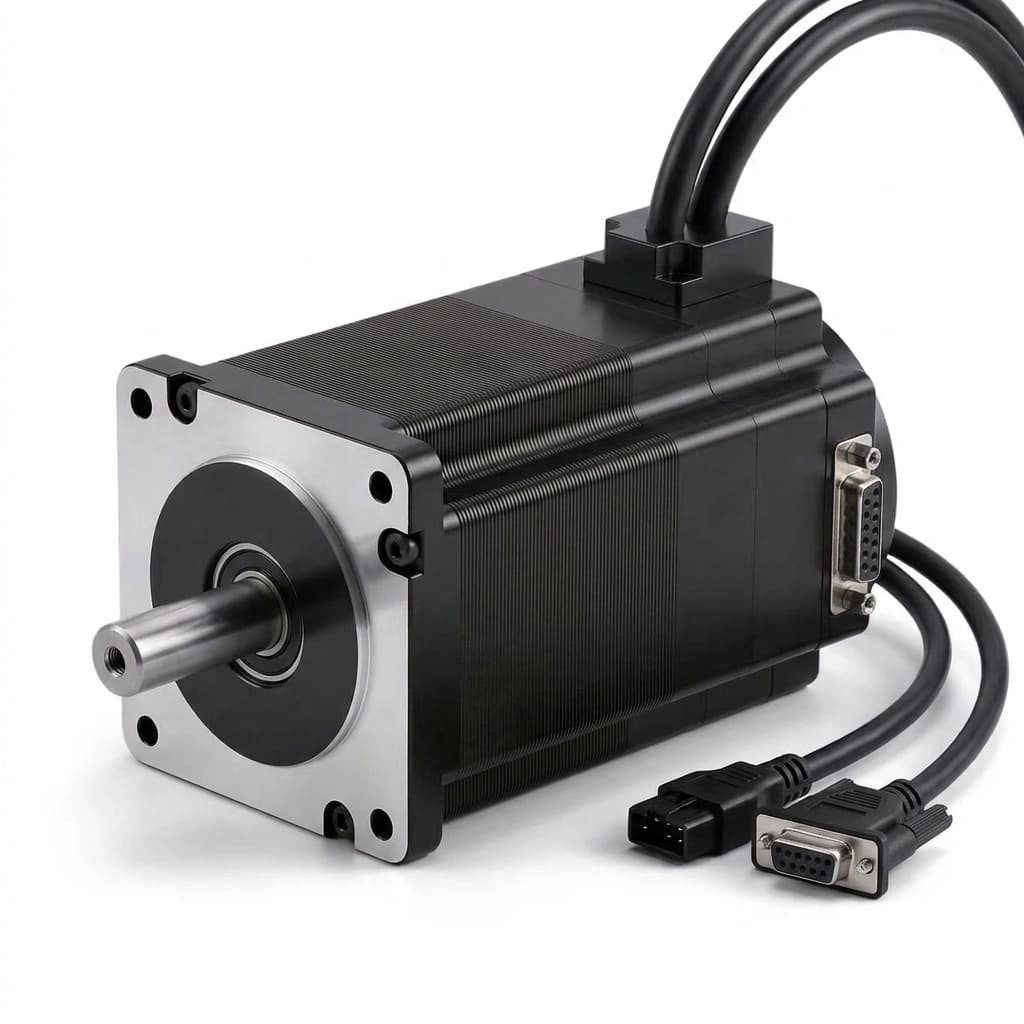
Closed-Loop NEMA Stepper Motors: The 2026 OEM Selection Guide
Use this OEM guide to compare open-loop and closed-loop NEMA stepper motors: torque margins, encoder feedback, BOM tradeoffs, sizing limits, and RFQ checks.
"Why pay 30% more for a closed-loop stepper when an open-loop NEMA 23 works fine?"
For years, the answer for many OEMs was simply: you shouldn't. But for teams evaluating NEMA stepper motors in 2026, lower-cost encoder options and more integrated drives have changed the tradeoff. Closed-loop stepper motors, often called stepper servos, are no longer just a luxury upgrade; they are a practical baseline when missed steps, motor heat, re-homing downtime, or field recalibration have measurable cost.
This guide is scoped to global OEM sourcing of NEMA 17, NEMA 23, and NEMA 34 hybrid steppers for packaging, CNC, lab automation, dispensing, and light industrial equipment. The numbers below are RFQ screening ranges, not guaranteed quotes; final selection still needs the supplier's speed-torque curve at your bus voltage, payload test data, and alarm behavior validation.
The engineering reality: Torque vs. Speed
In a traditional open-loop system, engineers often over-spec the motor by 30-50% to keep enough torque margin for acceleration, friction changes, and occasional overloads. This can create heavier axes, more idle heat, and larger power supplies.
Closed-loop systems continuously monitor rotor position. If the load suddenly increases but remains inside the motor and driver torque envelope, the drive can raise current and recover commanded position. If the overload exceeds that envelope, the useful feature is not a guarantee that overloads disappear; it is a following-error alarm or controlled stop instead of silent lost steps.
Quick Sizing Rules for RFQ Screening
Use these rules before requesting samples or approving a drop-in replacement:
- Size from required torque at target speed, not holding torque. NEMA frame size alone does not guarantee high-speed torque.
- Keep about 20-30% dynamic torque reserve for a closed-loop stepper after acceleration and friction are included. Use a larger frame or servo if continuous load consumes that reserve.
- Check the drive bus voltage and current limit against the supplier speed-torque curve; many NEMA 23 failures are voltage-limited, not frame-size-limited.
- Match encoder resolution to the allowed following-error window. A common NEMA 23 or NEMA 34 RFQ may specify 1000-line / 4000-count-per-revolution feedback, but the required resolution depends on screw pitch, pulley ratio, and allowable error.
- Ask for the alarm output, recovery mode, and fault threshold in writing. Procurement should not accept "closed loop" unless the driver behavior is testable at the machine controller.
Cost and Performance Matrix (2026 Baselines)
When making procurement decisions, consider the total system value, not just the motor unit price. Treat these as 2026 RFQ planning ranges for industrial NEMA 23 systems; volume, encoder type, cable set, and matched drive availability can move the final quote.
| Parameter | Open-Loop NEMA 23 | Closed-Loop NEMA 23 | AC Servo (400W) | Why it matters to OEMs |
|---|---|---|---|---|
| BOM Cost (Motor + Drive) | Lowest baseline | Often +20-50% vs open-loop | Often 2x+ vs open-loop | Defines your BOM budget limit. |
| Position Accuracy | Relies on mechanics and no missed steps | Encoder-verified position | Encoder-verified position | Essential for CNC, dispensing, and packaging. |
| High-Speed Torque | Drops significantly | Sustained better | Excellent | Machine throughput limitations. |
| Tuning & Commissioning | Plug & Play | Auto-tuning available | Complex PID tuning | Engineering hours per machine. |
| Heat Generation | High if configured for full holding current | Lower when current is demand-based | Very low for equivalent duty | Determines enclosure cooling needs. |
| Failure Response | Can lose position silently | Corrects within limit or alarms beyond it | Corrects within limit or alarms beyond it | Warranty claims and field downtime. |
OEM Selection Checklist: Is Closed-Loop Justified?
Before approving the BOM change from open to closed-loop, run your application through this validation checklist:
- Variable Payload: Does the machine handle varying weights (e.g., dispensing different fluid volumes, variable friction)? If yes, closed-loop is highly recommended.
- Throughput vs. Cost: Do you need higher speeds than open-loop allows, but lack the budget for AC Servos?
- Thermal Limits: Is the motor enclosed in a tight space where continuous max-current open-loop heating would damage nearby components?
- No Silent Missed Steps: Would a single missed step crash a toolhead or ruin a batch of expensive material?
- Encoder Specs: Does your supplier define encoder type, CPR, shielding, connector, and replacement availability instead of only saying "with encoder"?
- Cable Management: Can your cable chain accommodate the extra encoder cables without exceeding bending radius limits?
Sourcing and Supply Chain Considerations
If you decide to upgrade, pay attention to the encoder type. Magnetic encoders can be better in dust, oil, vibration, and cost-sensitive equipment, while optical encoders still fit high-resolution and low-noise positioning needs. Do not treat them as interchangeable; put encoder technology, CPR, cable shielding, connector type, ingress protection, and spare-part availability into the RFQ.
For volume OEMs, ensuring stable supply of the specific matched driver is just as critical as the motor itself. The closed-loop algorithm relies heavily on tight integration between the driver and the encoder feedback loop.
Frequently Asked Questions (FAQ)
Can I run a closed-loop stepper motor with a standard open-loop driver?
No. To utilize the closed-loop functionality, you need a dedicated driver capable of processing the encoder feedback in real-time. Running it on a standard driver will turn it into a heavy, expensive open-loop motor.
Do closed-loop steppers hunt for position at rest like AC servos?
Usually no. Stepper motors have natural holding torque due to their internal detents, so a properly configured closed-loop stepper normally holds position without continuous hunting. Vibration can still appear if current, microstepping, resonance, or alarm settings are wrong.
Are closed-loop steppers plug-and-play?
Most modern closed-loop drives feature auto-tuning, making them easier to commission than many AC servo systems. You still need to set current limits, following-error thresholds, acceleration ramps, and controller fault handling.
When should I skip closed-loop and choose an AC servo?
Choose an AC servo when the axis needs high continuous speed, high power density, frequent torque overload, or precise velocity regulation beyond the useful range of a hybrid stepper. Closed-loop steppers are strongest when the load is moderate, positioning is point-to-point, and BOM cost matters.
Sources and References
- Texas Instruments: Closed Loop Stepper Motor Design With Encoder for Stall Detection Reference Design - encoder feedback and missed-step detection architecture. ti.com
- Applied Motion Products: Encoder Feedback in Step Motor Systems - practical closed-loop functions such as stall detection and stall prevention. applied-motion.com
- Oriental Motor: Magnetic Encoders vs Optical Encoders - encoder tradeoffs for dust, oil, vibration, durability, cost, and precision. orientalmotor.com
- ISO 12100: Safety of machinery - General principles for design - Risk assessment and risk reduction - risk-assessment framing for machine faults and crash prevention. iso.org
Next Steps for Your Project
Ready to transition to a more reliable motion system? If you have an existing open-loop design that is experiencing thermal issues or step loss, our engineering team can help you map out a drop-in replacement strategy.
Check our NEMA 23 Stepper Motors and NEMA 34 Stepper Motors to see integrated closed-loop options, or send your torque and speed requirements directly to [email protected] for a free design review.
Author

Categories
More Posts
NEMA Stepper Motor Industry Update (April-May 2026): Tariff Mechanics, Standards Activity, and Buyer Decisions
April-May 2026 NEMA stepper update for OEM teams: U.S. tariff shifts, NEMA standards activity, frame-size and driver-current tradeoffs, and PO-release controls.
Stepper Motor vs Servo Motor: An OEM Buyer's Decision Framework
When to use stepper motors vs servo motors in industrial machines. Includes cost models, performance comparison data, and a structured decision tree for OEM procurement teams.
CE, RoHS, and UL Compliance for NEMA Stepper Motors in 2026
Source compliant NEMA stepper motors in 2026 with CE, RoHS, UL, and REACH checks, supplier RFQ questions, and document evidence before quote.