LogoNEMA Stepper Motors
Start inquiry
LogoNEMA Stepper Motors
WhatsApp
LogoNEMA Stepper Motors

China-based NEMA stepper motor factory supporting OEM customization, quality control, and global delivery.

Inquiry Email

[email protected]

Email app

Instant Chat

+8618857971991

Chat on WhatsApp

Direct response from our engineering team.

Products
  • NEMA Frame Stepper Motors
  • Hybrid Stepper Motors
  • Drivers & Controllers
Solutions
  • CNC & Machine Tools
  • 3D Printing & Robotics
  • Medical & Laboratory Equipment
OEM Capabilities
  • Custom Design & Engineering
  • Prototype & Validation
  • Quality & Compliance
Resources
  • Blog
  • About
  • Contact / RFQ
  • Privacy Policy
  • Cookie Policy
  • Terms of Service
© 2026 NEMA Stepper Motors. All Rights Reserved.|Traded as Linkup Ai., Co Ltd

Hybrid Tool + Report

Published: 2026-05-07 | Updated: 2026-05-12 | Reviewed by NEMA Stepper Motors engineering team

1 10th RPM Stepper Motor Telescope Drive: Calculator and Engineering Decision Guide

Run the calculator first to validate pulse demand, torque reserve, and output resolution. Then verify whether your 0.1 RPM requirement is motor-side or axis-side, because telescope sidereal tracking usually maps 0.1 RPM to the motor after reduction rather than to the final output axis.

Request RFQ ReviewRun 0.1 RPM Calculator
1. Run calculator2. Check tracking boundary3. Verify method and risk

Visible risk disclosure

This page provides engineering screening guidance, not a final certification. Always confirm torque-speed behavior, backlash, and thermal stability using your real load and ambient conditions.

Research refresh

Core conclusions were refreshed against primary sources on 2026-05-12 (USNO, NASA/JPL, TI, Leadshine, Sky-Watcher, iOptron, Celestron, Neugart, Harmonic Drive, Oriental Motor).

Tool Layer

0.1 RPM Stepper Feasibility Calculator

Use this first-pass tool to test whether your pulse budget, gear ratio, and torque assumptions can realistically deliver low-speed output, including sidereal-axis values around 0.000696 RPM.

Empty state: enter your target speed and torque, then run the calculator to get pulse demand, torque reserve, and a next-step action plan.

Controller / PLCPulse stream (Hz)Stepper DriverkHz budget ceilingStepper MotorStep angle + torqueGearhead + LoadOutput RPM, backlash, thermal margin

Telescope Boundary: 0.1 RPM Is Usually Motor-Side, Not Axis-Side

The star-tracking axis runs near 0.000696 RPM (sidereal). The headline 0.1 RPM typically appears after gearbox conversion on the motor side.

RPM reference boundary for telescope trackingAxis-side sidereal speed60 / 86164.09054 = 0.00069635 RPM× gear ratioexample: 144:1Motor-side speed target0.10027379 RPM (sidereal @ 144:1)Boundary rule: state tracking mode first, then convert to RPM. "0.1 RPM" alone is incomplete.Solar-day motor speed at 144:1 is 0.10000000 RPM, which differs by +0.27304% from sidereal.
Reference ModeTime BaseAxis RPMMotor RPM @ 144:1Decision Impact
Sidereal tracking (stars)23h 56m 04s interval (USNO)0.00069635 RPM0.10027379 RPMUse this when tracking stars. At 144:1 ratio, 0.1 RPM is a motor-side approximation, not the axis speed.
Solar-day tracking reference24h 00m 00s (86400 s)0.00069444 RPM0.10000000 RPMThis matches solar-day pacing. If used for sidereal objectives, stars drift over time.
Sidereal vs solar delta235.90946 s/day gap (JPL constants)+0.27304%+0.00027379 RPMController tracking mode must be explicit. A solar-rate command on sidereal targets creates about 147.85 arcsec/hour drift before guiding corrections.

Tracking-Mode Error Budget (Derived, Not Assumed)

Using JPL constants (86164.09054 s sidereal day and 86400 s solar day), a solar-rate command on a sidereal objective introduces a deterministic drift term even before backlash or periodic error is considered.

Time WindowDerived DriftConditionDecision Meaning
600 s (single worm cycle on many 144-tooth examples)24.64 arcsecSolar-rate command used while objective is sidereal tracking (JPL constants).Already large enough to consume a significant portion of sub-arcminute error budgets if uncompensated.
1 hour147.85 arcsec (2.46 arcmin)Same mode mismatch, no external guiding or PEC compensation applied.Mount control mode cannot be left implicit in RFQ or firmware requirements.
8-hour session1182.78 arcsec (19.71 arcmin)Mismatch sustained over long exposure window.Night-long drift from reference mismatch can dominate total tracking error even if mechanics are otherwise acceptable.

This is a mode-selection drift term only. Real error can be larger once periodic error, backlash, and wind/load disturbances are superimposed.

Core Conclusions and Key Numbers

These decision points summarize what matters most when your target is stable ultra-low-speed output with clear reference mode.

Pulse-domain conclusion

Sidereal-axis tracking often sits in single-digit to tens of Hz, even when motor-side speed is near 0.1 RPM.

In telescope use-cases, low-frequency behavior and resonance mitigation are often more critical than raw kHz pulse ceiling.

Torque-domain conclusion

Ratio-only sizing is unsafe without efficiency and reserve factors.

Treat 1.3x reserve as minimum screening threshold, and move to higher reserve for high-friction or high-temperature duty. This threshold is a planning heuristic, not a universal standard.

Precision-domain conclusion

Backlash class often determines success more than raw motor size.

For low-speed reversal accuracy, ask for published arcminute data and verify bidirectional repeatability before release.

Run tool resultPulse + torque + resolutionPass: reserve >= 1.3x, utilization <= 80%Move to prototype validation checklistWarning: borderline pulse/torque marginKeep candidate, require extra test gatesRFQ ActionAsk for backlash + thermal + repeatability proof

Applicable / Not Applicable Profiles

SegmentTypical ProfileDecision Meaning
SuitableTelescope RA drives (with explicit sidereal mode), indexing tables, valve positioning, slow tracking axesBest fit when low-speed steadiness and repeatability matter more than high acceleration bandwidth.
Conditionally suitableLow-cycle robotic joints and compact linear stagesWorks when backlash and torsional stiffness are validated under bidirectional reversals.
Not suitableHigh-dynamic servo replacement, sub-arcminute metrology without compensation, high-shock duty0.1 RPM stepper stacks are poor fit when dynamic responsiveness or ultra-high absolute accuracy dominates.

Methodology and Evidence Layer

The calculator combines three checks: pulse budget feasibility, output torque reserve, and practical low-speed risk warnings.

Evidence and constants were refreshed on 2026-05-12. Internal thresholds (for example 1.3x reserve and 80% pulse utilization) are planning heuristics and should be replaced by project-specific validation criteria.

Required Pulse Frequencyf(Hz) = RPM × steps/rev × microstep × ratio / 60Max Output RPM at Driver CeilingRPMmax = fmax × 60 / (steps/rev × microstep × ratio)Estimated Output TorqueTout = Tmotor × ratio × efficiencyReserve RatioReserve = Tout / Trequired (target ≥ 1.3x)
Evidence TopicUsable FindingSourceChecked Date
Sidereal interval and daily shiftUSNO defines a sidereal day as 23h 56m 4.0905s and notes sidereal time advances by about 3m56s per mean solar day.U.S. Naval Observatory sidereal time service2026-05-12
Day vs mean sidereal day constantsNASA/JPL lists day = 86400 s and mean sidereal day = 86164.09054 s, enabling direct conversion from tracking mode to required axis RPM.NASA JPL Solar System Dynamics constants2026-05-12
Driver pulse ceiling and timing constraintsLeadshine EM542S documentation lists 200 kHz max pulse input. Related DM542 manuals publish 2.5 us minimum pulse width and 5 us minimum direction setup.Leadshine EM542S page + DM542-class manuals2026-05-12
Microstepping boundary (2026 update)TI states microstepping improves smoothness and acoustic behavior, but does not inherently improve absolute positioning accuracy because of motor non-linearity.Texas Instruments application brief SLVAES8A (Revised Feb 2026)2026-05-12
Motor stop accuracy boundaryOriental Motor publishes stop-positioning accuracy around ±3 arcmin (±0.05°) for 1.8° motors under no-load conditions, and clarifies this is a motor-level metric.Oriental Motor technology overview2026-05-12
Start-stop vs slew-region operationOriental Motor differentiates self-starting (start-stop) region from slew region and notes low-speed resonance is often most pronounced around ~100-200 Hz.Oriental Motor stepper motor basics2026-05-12
Mount controller tracking and guide-rate controlsSky-Watcher SynScan V4 manual exposes sidereal/lunar/solar tracking selections and auto-guide speed from 0.125x to 1.0x sidereal.Sky-Watcher SynScan V4 hand controller manual2026-05-12
Worm-cycle planning inputs (example platform)iOptron SkyHunter publishes 144-tooth RA/DEC worm wheels and a 600 s worm period, plus sidereal/lunar/solar/custom tracking options.iOptron SkyHunter specifications2026-05-12
Telescope controller tracking modes (cross-check)Celestron documentation lists sidereal, solar, and lunar tracking-rate options with Alt-Az and EQ tracking modes.Celestron 60LCM documentation2026-05-12
Planetary gearbox efficiency and backlash classesNeugart PLFN publishes nominal efficiency >95% and backlash classes from 3 to 15 arcmin depending on ratio and class.Neugart PLFN official product page2026-05-12
Strain-wave gear precision boundaryHarmonic Drive reports zero backlash behavior and efficiency >90% with ratio options up to 160:1 for CSG/SHG units.Harmonic Drive technology page2026-05-12

Unknowns and assumptions are explicit: gear efficiency and backlash can vary by supplier model, and microstepping does not guarantee absolute accuracy. This page treats those items as validation gates instead of fixed truths.

Need a validated stack recommendation?

Send your target torque, ratio, and ambient constraints for a practical RFQ checklist before supplier lock-in.

Request RFQ ReviewContact Sales Engineering

Gearbox Comparison and Tradeoffs

OptionRatio BandBacklash NoteTradeoff Summary
Parallel shaft gearheadBroad ratios available; verify by specific vendor modelPublic ranges are fragmented; backlash may vary widely by build classCan be cost-effective, but decision quality is lower without model-level backlash and wear data.
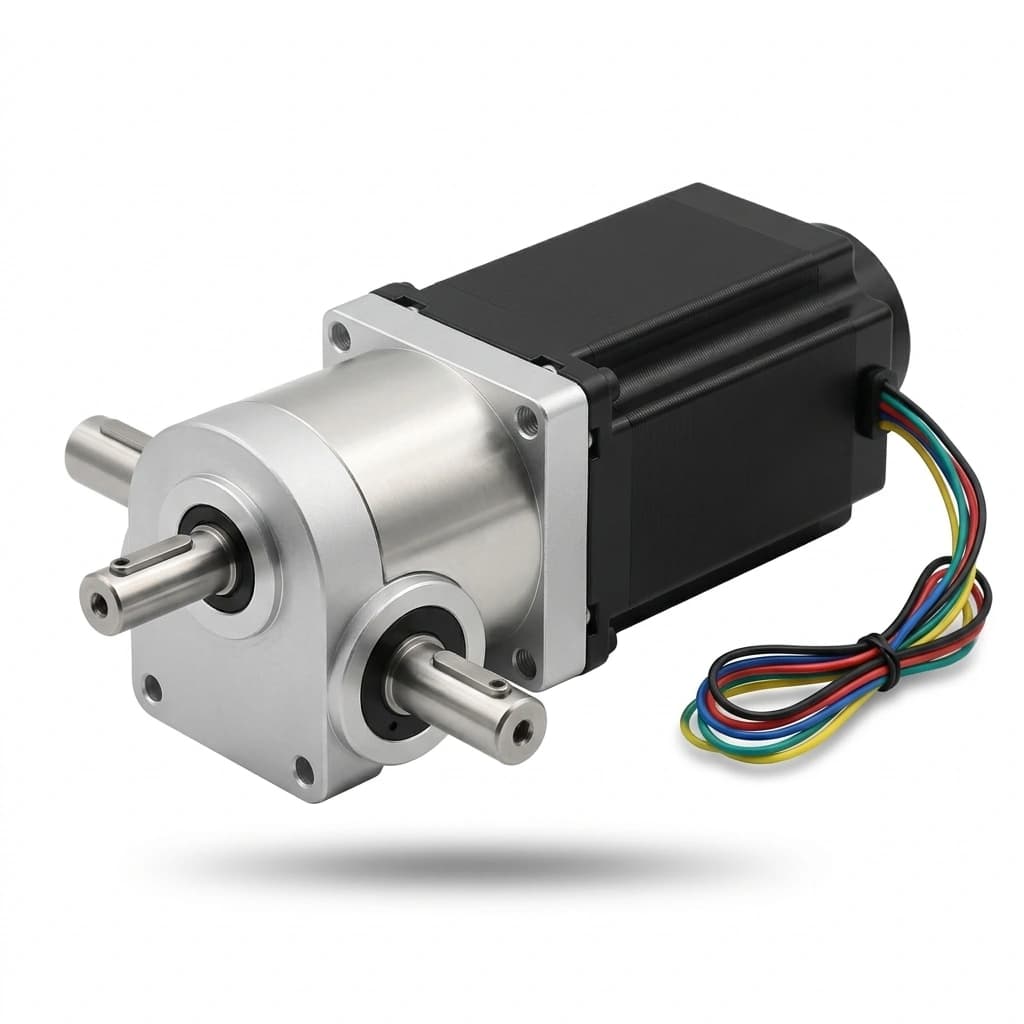
Planetary gearheadNeugart PLFN publishes 3:1 to 100:1 classesPublished classes include 3-15 arcmin with >95% efficiencyGood balance when you need procurement availability plus documented efficiency/backlash classes.
Harmonic or strain-waveOfficial CSG/SHG examples list 30:1 to 160:1Zero-backlash behavior with >90% efficiency is publishedPrecision-focused choice; higher cost and integration constraints must be priced into the project.
Typical backlash tendency (lower is better for reversal precision)Parallel ShaftOften broader backlash spread; verify model-by-model.PlanetaryLow-backlash classes available; published arcminute ranges are common.HarmonicNear-zero backlash classes; evaluate cost and torsional behavior.

Sidereal-Axis Pulse Examples (Telescope-Specific)

Assumptions: 1.8 degree motor, sidereal-axis target (0.00069635 RPM), and 200 kHz driver pulse ceiling for utilization reference.

Gear RatioMicrostepRequired PulsePulse UtilizationInterpretation
100:1163.71 Hz0.0019%Deep low-frequency regime. Pulse ceiling is not the bottleneck; smoothness and resonance control dominate.
144:1165.35 Hz0.0027%Represents sidereal-axis planning with motor speed near 0.1 RPM.
200:1167.43 Hz0.0037%Higher ratio increases motor-side speed and pulse demand but remains low-frequency.
360:13226.74 Hz0.0134%Still well below typical kHz-level driver ceilings; timing granularity and mechanical quality become key risks.

Pulse-Budget Table for Motor-Side 0.1 RPM Planning

Example numbers below assume a 1.8 degree motor (200 steps/rev). Use this as a screening matrix, then replace with your actual driver and mechanics data.

Target RPMGear RatioMicrostepRequired Pulse (Hz)Interpretation
0.1050:116266.7Usually easy for modern digital drives, but verify low-speed ripple.
0.10100:116533.3Common for low-speed tracking; still far below 200 kHz class driver limits.
0.10200:1322133.3Pulse demand climbs quickly with high ratio + high microstep combinations.
0.10400:1648533.3Still below driver ceiling, but controller timing quality and direction setup matter.

Controller Capability Comparison (Primary Manuals)

These controller facts are useful for requirement wording and test planning, but they are not substitutes for end-to-end tracking validation under real load.

PlatformPublished ControlsDecision BenefitBoundary / Limitation
Sky-Watcher SynScan V4Tracking mode includes sidereal/solar/lunar selections; auto-guide speed configurable 0.125x to 1.0x sidereal.Lets teams tune correction aggressiveness around the sidereal base.Controller feature availability does not prove end-to-end tracking accuracy under load.
iOptron SkyHunterRA/DEC worm wheel 144 teeth and published 600 s worm period with sidereal/lunar/solar/custom tracking rates.Gives explicit periodic-error test window and tracking-rate context for bench validation.Platform-specific numbers are not universal across all telescope mounts.
Celestron NexStar-class control docsTracking rate options include sidereal, solar, lunar; tracking modes include Alt-Az and EQ.Confirms that reference-rate choice is a normal operator-facing control, not a hidden engineering constant.Mode labels alone do not provide backlash, periodic error, or thermal drift guarantees.

Concept Boundary: What Each Metric Proves (and Does Not)

MetricWhat It Can ProveWhat It Cannot ProveMinimum Action
Motor stop-position accuracyMotor-level step placement capability (for example ±3 arcmin no-load values in vendor references).Gearbox backlash, worm periodic error, structural flex, or tracking drift over time.Use as motor screening input only; verify full-axis tracking and reversal repeatability on assembled hardware.
Microstepping settingSmoother current waveform and potentially lower vibration/noise at low speed.Guaranteed absolute accuracy improvement or linear per-microstep motion.Treat microstepping as smoothness tuning; validate actual axis error with encoder or guider logs.
Controller tracking mode (sidereal/solar/lunar)Reference-speed basis selected by firmware and operator.Correct behavior if requirement text, firmware mode, and test condition are misaligned.Lock tracking reference mode in requirement docs and acceptance tests before sizing decisions.
Worm period / tooth count dataA concrete minimum duration for one full periodic-error observation cycle.Cross-platform equivalence, because different mounts use different ratios and machining quality.Measure at least one full worm cycle on the exact target mount before release sign-off.

Risk Matrix and Mitigation

ImpactProbabilityPulse jitterMicrostep linearityThermal driftBacklash reversalReference mismatchOverstated efficiency
RiskProbabilityImpactMitigation Action
Tracking reference mismatch (sidereal vs solar)High when requirement text is ambiguousAbout 147.85 arcsec/hour tracking drift can accumulate before guiding if reference mode is wrong.Lock requirement language to sidereal/solar/lunar mode, then convert to axis RPM and verify controller mode during FAT/SAT.
Backlash under reversalMedium to HighPositioning drift and deadband near setpointSpecify backlash target in arcminutes, require bidirectional repeatability report, and test at your real load friction.
Pulse timing jitter at controller levelMediumMicro-oscillation at ultra-low speed and occasional lost synchronizationKeep pulse utilization margin, enforce pulse-width/direction setup timing, and validate cable/grounding strategy.
Microstep linearity over-trustMediumFalse confidence in absolute positioning despite smoother motion profileTreat microstepping as smoothness tool first; validate absolute error with encoder or star-tracking logs.
Thermal drift in long dwellMediumTorque reserve collapse over time and increased positioning errorRun 30-60 minute soak test at worst ambient, and tune holding current/idle-current reduction settings.
Over-optimistic efficiency assumptionHigh in early RFQ stageUnderestimated torque requirement and incorrect motor size selectionUse conservative efficiency in first-pass sizing and replace with measured data before release.

Evidence Gaps You Must Close Before Release

The following items are intentionally marked as uncertain because reliable public benchmarks are incomplete or non-transferable.

Decision ItemStatusWhy Public Data Is InsufficientMinimum Action
Full-cycle periodic error after final assembly (arcsec peak-to-peak)Pending confirmationNo reliable universal public benchmark exists because machining quality, preload, and integration vary by mount platform.Request one full worm-cycle tracking error curve from supplier or verify with guider logs before release.
Backlash growth after life-cycle wear at actual ambient/loadPending confirmationCatalog backlash values are usually new-condition values; wear progression is application-specific and rarely published in open data.Define end-of-life backlash acceptance criteria and ask for durability test evidence.
Torque derating under enclosure thermal soak for your duty cyclePublic evidence insufficientGeneral thermal notes exist, but model-specific derating under your enclosure airflow and dwell profile is not publicly standardized.Run 30-60 minute thermal soak with your true duty cycle and document pass/fail thresholds in RFQ.

Scenario Demonstrations

Each scenario includes premise, process, and outcome so teams can directly map the method into procurement reviews.

ScenarioPremiseProcessOutcome
Telescope tracking axisSidereal output is around 0.000696 RPM; with 144:1 reduction this maps to about 0.100274 RPM motor-side.Define tracking reference first, then validate low-frequency behavior, backlash, and at least one full worm-cycle periodic-error run (about 600 s on many 144-tooth examples).Main failures are usually requirement mismatch or mechanics drift, not driver pulse ceiling.
Batch indexing fixture0.1 RPM hold plus periodic reversals, repeatability more important than absolute speed.Define backlash limit and reserve ratio >=1.8x, then run bidirectional cycle test.Parallel shaft can work for cost, but precision planetary often reduces rework risk.
Valve actuator with long dwellHigh holding time and elevated ambient inside enclosure.Model thermal rise, reduce idle current, and verify 60-minute temperature plateau.Many failures are avoided by current derating and thermal design before PO.
Precision lab stageVery small reversible moves around target point with strict error tolerance.Treat standard gearhead as high-risk; evaluate harmonic and compensation strategy.If ultra-tight repeatability is required, a servo or closed-loop architecture may be safer.

Contextual Internal Links

  • Driver Selection: DM542 vs DM556 vs DM860 for pulse-input and driver-class tradeoffs.
  • Thermal Management for OEM Machine Builders for hold-current and enclosure heat validation.
  • NEMA 17 vs NEMA 23 Selection Guide for frame-size and torque-margin decisions.
  • Drivers and Controllers when you need product-level sourcing follow-up.
  • OEM Program Overview for production capability, QC scope, and collaboration flow.
  • Contact Sales Engineering when your team needs lead-time and RFQ turnaround planning.

FAQ: 0.1 RPM Stepper Decision Questions

These questions are grouped around selection, validation, and procurement decisions rather than glossary definitions.

Inquiry Email

[email protected]

Email app

Instant Chat

+8618857971991

Chat on WhatsApp

Direct response from our engineering team.