
AC pack vs DC stack
110V is a procurement architecture question first
The phrase can describe mains-fed cabinets, AC-input driver packs, or DC drives sold with 110/120VAC supplies. Treat input architecture as the first filter.
Hybrid Tool + Report
Start with the distributor path checker to decide whether your RFQ should ask for an AC-input driver pack, a DC drive plus isolated supply, or supplier engineering review. Then use the report layer to verify architecture, current margin, sourcing evidence, and purchase risks on the same canonical URL.
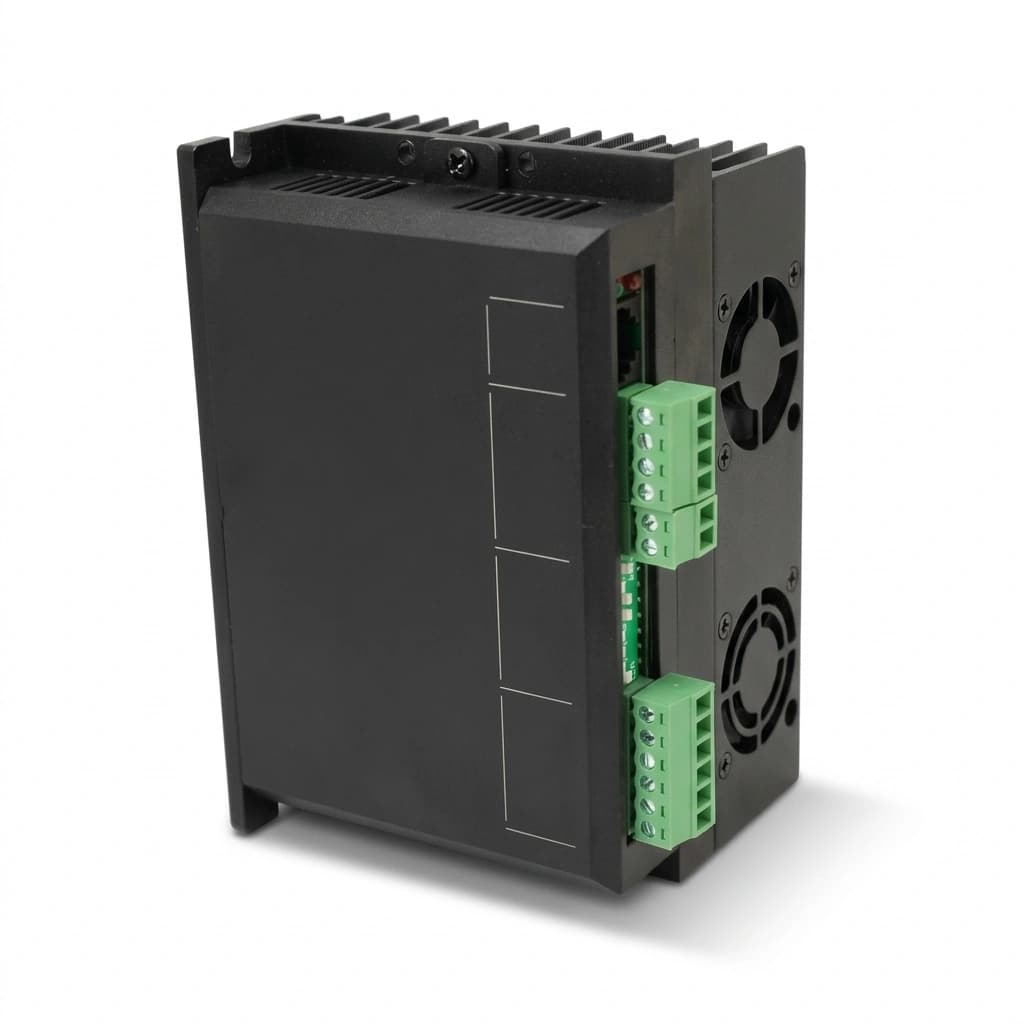
Visible safety boundary
This page screens procurement architecture and RFQ evidence. It is not mains wiring instruction and does not replace certified panel-design, protection, EMC, or safety review.
Source refresh timestamp
Evidence and assumptions were reviewed on 2026-06-06. Recheck model-specific distributor documents before purchase order release.
Tool Layer
Enter current, axis count, supply context, and cabinet constraints. The tool returns a deterministic distributor path with source-aware caveats and an RFQ-ready next step.
Boundary notes: the tool screens procurement architecture only. It does not certify mains wiring, branch protection, EMC, insulation, or safety compliance.
Empty state: run the checker to decide whether your distributor RFQ should ask for a 110/120VAC input driver pack, a DC drive plus isolated supply, or supplier engineering review.
The practical answer is not “buy any 110V driver.” The first decision is which distributor evidence path fits your machine.
AC pack vs DC stack
110V is a procurement architecture question first
The phrase can describe mains-fed cabinets, AC-input driver packs, or DC drives sold with 110/120VAC supplies. Treat input architecture as the first filter.
phase current x 1.2-1.3
Current class still decides the driver family
A 110V supply does not remove current and thermal limits. Ask distributors to quote by motor phase current, cabinet ambient, and duty cycle.
90-130VAC screening range
100-120VAC catalogs are not interchangeable
Some systems accept 100-120VAC, some accept 120VAC nominal, and many stepper drives require DC input. Confirm voltage tolerance and approvals on the exact model.
4+ axes triggers diversity review
Multi-axis projects need cabinet-level review
A single-axis quote can miss branch protection, power diversity, regeneration, cable routing, and cooling requirements in a production cabinet.
datasheet + lead time + compliance
Distributor value is evidence, not just availability
A useful distributor should return model-specific documentation, stock/lead time, substitution rules, and engineering caveats before purchase order release.
| Metric | Preferred Band | Warning Band | Decision Meaning |
|---|---|---|---|
| Available mains | 100-120VAC nominal, documented 90-130VAC tolerance | Exact 110VAC claim without tolerance range | Distribution voltage varies by country and facility. Tolerance matters more than the label printed in a listing. |
| Driver input architecture | Explicit AC-input pack or explicit DC-input drive + supply | Listing says “110V” but omits AC/DC input | AC/DC ambiguity is the main source of wrong distributor quotes for this keyword. |
| Current headroom | >=1.2x motor phase current after derating | Current rating equals motor phase current at warm ambient | Thermal derating and enclosure temperature can erase catalog current margin. |
| Estimated supply power | Calculated from bus, axes, duty, and diversity | One supply wattage copied across all machines | Multi-axis machines rarely draw all peak current continuously, but undersized supplies trip under acceleration. |
| Compliance package | Model datasheet, manual, CE/UL notes, warranty, lead time | Marketplace listing with no approval or manual | Distributor selection is partly risk transfer; documentation is part of the product. |
The second pass focused on closing the gaps created by the ambiguous do/know split in the keyword.
| Gap Found | Impact | Enhancement |
|---|---|---|
| Current page stated “AC pack vs DC stack” but did not show enough model-level proof | A buyer could accept the architecture split as opinion instead of seeing that public catalogs actually expose separate AC-input and mixed AC/DC product classes. | Added source-backed data points from Applied Motion, Oriental Motor, and Leadshine with explicit voltage, current, ambient, and input-architecture facts. |
| Safety boundary was present but too general for panel procurement | A distributor quote can cover a component, a listed industrial control panel, or a machine electrical package; confusing those scopes changes liability and documentation needs. | Added UL 508A and IEC 60204-1 boundary notes with date-stamped source rows and a decision table that distinguishes component-only from panel/machine review. |
| The page did not explicitly mark what public evidence cannot prove | Statements about market availability, lead-time premiums, or compliance sufficiency would be overclaims without distributor quotes or certificates. | Added explicit unknown-status rows for market share, lead-time premium, and quote-specific compliance sufficiency. |
| Power sizing and high-speed torque needed clearer applicability limits | Readers could treat the tool estimate or the 110V label as a guaranteed performance result instead of a screening input. | Added concept-boundary rows for higher bus voltage, torque-speed evidence, substitutes, and the non-certification status of the supply estimate. |
The tool uses deterministic procurement screening. The report layer makes assumptions visible and separates known facts from model-specific details that must be confirmed.
| Method Step | Calculation / Logic | Output |
|---|---|---|
| 1. Classify input architecture | AC-input required if buyer needs mains-ready package, retrofit cabinet fit, or multi-axis cabinet support. | AC pack, DC stack, or engineering review path |
| 2. Estimate bus and power | Rectified 110VAC rough bus uses VAC x 1.35; DC-stack path uses selected DC bus. Supply estimate applies axis count, current, speed, ambient, and diversity. | Estimated DC bus and minimum supply wattage |
| 3. Apply boundary gates | High current, hot ambient, 5+ axes, or high power moves the result to distributor engineering review. | Controlled boundary state instead of unsafe catalog advice |
| 4. Build RFQ evidence request | Tool output is translated into documentation and test requests: input range, current derating, torque-speed curve, thermal limits, approvals, and lead time. | RFQ-ready next action |
Use this table to keep AC-input packs, DC stacks, integrated assemblies, and engineering review from competing as if they were identical distributor products.
| Path | Best For | Ask Distributor For | Watch Out |
|---|---|---|---|
| AC-input driver pack | Retrofits, industrial cabinets, and buyers who need fewer discrete power components | 100-120VAC input range, current class, approvals, brake handling, enclosure cooling, lead time | Higher cost, narrower substitution options, and model-specific compliance details |
| DC drive + isolated supply | Compact systems, lower-current axes, prototypes, and BOMs that favor replaceable modules | DC voltage range, supply wattage, isolation, fuse guidance, torque-speed curve at selected bus | Mains wiring remains in the supply layer; current derating and grounding still need review |
| Integrated motor + drive | OEM machines that value reduced wiring, simpler replacement, and validated motor-drive pairing | Input voltage, communication interface, IP rating, thermal limits, cable kits, spare strategy | Less flexibility if motor frame, connector, or firmware changes later |
| Supplier engineering review | High current, 5+ axes, hot cabinets, high inertia, vertical axes, or formal compliance work | Application review with duty cycle, load inertia, regeneration, safety, and compliance notes | Longer quote cycle but lower probability of expensive field mismatch |
The lowest unit price is rarely the cleanest purchase path. Compare documentation, substitution, wiring, and replacement constraints.
| Dimension | AC Pack | DC Stack | Integrated Assembly |
|---|---|---|---|
| Initial quote speed | Medium: fewer parts but distributor may need exact model match | Fast: broad catalog availability for drives and supplies | Medium: supplier fit review often needed |
| Compliance clarity | High when approvals and manual are model-specific | Medium: supply and drive documentation must be combined | High if sold as a matched motor-drive assembly |
| Replacement flexibility | Medium: fewer equivalents | High: supply and drive can be substituted separately | Low to Medium: replacement tied to exact assembly |
| Wiring complexity | Medium: mains enters drive package | Medium to High: supply layer adds wiring and protection | Low: motor-drive wiring is reduced |
| Best procurement fit | Industrial retrofits and AC cabinet standards | Cost-sensitive OEM builds and prototypes | Repeat machines needing fast assembly and fewer wiring errors |
Public catalogs confirm broad architecture patterns, but exact ratings, approvals, and wiring rules are model-specific. Unknowns are intentionally marked for RFQ follow-up.
| Verified Fact | Evidence Detail | Decision Impact | Source |
|---|---|---|---|
| 120VAC AC-input packs are a real stepper-drive category | Applied Motion STAC5-120 is specified for 120VAC nominal, 50/60 Hz input, 0.5-5.0 A/phase peak-of-sine output, over/under-voltage and over-temperature protection, CE/UL 508c notes, and 0-40C ambient. | A distributor can quote a true AC-input drive pack, but the current class and ambient rating may be narrower than a buyer assumes from the “110V” label. | Applied Motion STAC5 datasheet |
| 100-115VAC systems do not put 100-115V directly on the windings | Oriental Motor states that 100-115VAC motor-driver systems rectify the input and apply approximately 140VDC to the motor, with exceptions by product. | Use “available mains” as an architecture input. Do not infer motor voltage, torque, or safe wiring from the AC label alone. | Oriental Motor stepper motor technology page |
| Some distributor listings mix AC and DC envelopes | Leadshine DMA860H lists 18-80VAC or 26-113VDC input, 1-7.2A peak output current, 200 kHz pulse input frequency, and optically isolated TTL-compatible inputs. | Require exact AC/DC input type, terminal labeling, and manual before treating a “110V” listing as a mains-ready package. | Leadshine DMA860H product documentation |
| Control-panel standards affect the quote boundary | UL 508A is active with a June 26, 2025 ANSI-approved revision and covers industrial control panels up to 1000V, but it does not evaluate whether the controlled load is adequate. | Ask whether the distributor is quoting only components, a listed panel, or a machine-level electrical package. These are different risk transfers. | UL 508A standard product page |
| Machine electrical review starts before the drive terminals | IEC 60204-1 is described as applying to machine electrical equipment and systems, and the covered equipment begins at the point where the supply connects to the machine electrical equipment. | For EU-facing machinery, RFQs should include cabinet documentation expectations, not only driver datasheets. | IEC 60204-1:2016 standard listing |
| Topic | Finding | Source | Checked |
|---|---|---|---|
| AC-input stepper drive class | Applied Motion STAC5 documentation lists the STAC5-120 as a 120VAC nominal, 50/60 Hz drive with 0.5-5.0 A/phase output current and 0-40C ambient rating. | Applied Motion Products STAC5 datasheet | 2026-06-06 |
| 100-115VAC rectified bus behavior | Oriental Motor explains that 100-115VAC motor-driver systems rectify the input and apply approximately 140VDC to the motor, with higher applied voltage improving current rise at high speed. | Oriental Motor stepper motor technology page | 2026-06-06 |
| Mixed AC/DC input driver envelope | Leadshine DMA860H public documentation lists 18-80VAC or 26-113VDC input and 1-7.2A peak output current, showing that “110V” listings can describe a driver envelope rather than a complete mains package. | Leadshine DMA860H product documentation | 2026-06-06 |
| Industrial control panel boundary | UL 508A covers general industrial control panels up to 1000V and states a 5-40C ambient basis unless another ambient rating is marked; it does not evaluate adequacy of controlled loads. | UL 508A standard product page | 2026-06-06 |
| Machine electrical equipment boundary | IEC 60204-1 is described as applying to electrical, electronic, and programmable electronic equipment of non-portable machines, starting at the machine electrical supply connection point. | IEC 60204-1:2016 standard listing | 2026-06-06 |
Public Evidence Limits
The sources above support architecture screening and RFQ questions. They do not prove that any specific distributor quote is safe, available, compliant, or thermally valid for your machine.
These boundaries prevent the most common over-readings of a 110V distributor listing. Use them as PO-release checks, not as generic buying slogans.
| Concept | Applies When | Does Not Apply When | Action |
|---|---|---|---|
| 110V driver | The exact model accepts a documented 100-120VAC or 110/120VAC input range, or the distributor bundles a listed supply with a DC-input drive. | A listing only says “110V” without AC/DC input type, input tolerance, terminal diagram, or installation manual. | Ask for input range, wiring manual, approvals, and whether the quote is component-only or panel-ready. |
| Higher bus voltage | Motor inductance and target speed require faster current rise, and the drive/motor thermal limits can support the selected current. | The motor lacks torque-speed data, the cabinet runs hot, cable length is high, or the drive current class is marginal. | Request torque-speed curves at the selected bus voltage and a sustained thermal test at cabinet ambient. |
| Distributor-stock substitute | The substitute matches input architecture, output current class, pulse interface, protection features, documentation, and compliance target. | Only the headline voltage or nominal current looks similar. | Freeze accepted substitutes, revision, manual version, and approval documents in the PO. |
| Tool supply wattage estimate | Used for first-pass RFQ routing and quote comparison among architectures. | Used as final panel certification, branch protection sizing, thermal validation, or EMC evidence. | Treat the estimate as a planning floor and require supplier validation before purchase release. |
| Unknown / Unproven Claim | Status | Why It Matters | Minimum Confirmation |
|---|---|---|---|
| Public market share of 110/120VAC AC-input stepper drives | No reliable public data yet | Without a defensible denominator, the page should not claim that AC-input packs are common or rare by percentage. | Distributor line-card count, manufacturer catalog export, or verified shipment data by input architecture. |
| Exact lead-time premium for AC-input packs versus DC stacks | Quote-specific confirmation required | Lead time is distributor- and model-specific, and 2026 stock can change faster than static catalog pages. | Written distributor quote with stock status, substitute policy, and validity date. |
| Compliance sufficiency of any individual quote | Quote-specific confirmation required | A component mark, a listed industrial control panel, and machine-level conformity are not equivalent. | Model certificates, panel label scope, installation manual, SCCR/branch protection data, and application review. |
These are the risks most likely to convert a cheap distributor quote into a late engineering change.
| Risk | Probability | Impact | Mitigation |
|---|---|---|---|
| AC/DC input ambiguity | High | Wrong product quoted or unsafe wiring assumptions | Require the distributor to state exact input type, input voltage range, and wiring manual before price comparison. |
| Current derating gap | Medium | Driver overheats or trips in warm cabinets | Request derating curves and run a 45-60 minute thermal soak at cabinet ambient. |
| Undersized supply | Medium | Voltage sag, nuisance faults, and lost torque during acceleration | Size supply from bus, axis count, duty cycle, speed band, and diversity assumptions; validate under worst acceleration. |
| Missing regeneration path | Low to Medium | Bus overvoltage during deceleration or vertical-axis motion | Ask for brake resistor or regeneration guidance when inertia, vertical load, or rapid decel is present. |
| Marketplace substitution | Medium | Same listing title ships a different revision or unlabeled replacement | Freeze exact model, revision, manual, warranty, and accepted substitutes in the purchase order. |
Use these as pattern matches for early RFQ routing. Exact model selection still depends on your motor and duty cycle.
Packaging machine retrofit
Premise: Two NEMA 34 axes, 110VAC cabinet, 4.2A phase current, 40C ambient
Process: Tool routes to AC-input pack shortlist and requests current derating, cabinet cooling, and brake guidance.
Outcome: Distributor quote focuses on mains-ready industrial packs instead of low-voltage board drivers.
Lab automation fixture
Premise: One NEMA 23 axis, 2.8A phase current, compact enclosure, separate supply allowed
Process: Tool routes to DC drive + isolated supply and estimates supply wattage for first-pass RFQ.
Outcome: Buyer compares replaceable drive/supply pairs with clearer cost and lead-time options.
Five-axis dispensing line
Premise: Five axes, long cables, mixed duty cycle, elevated cabinet temperature
Process: Tool triggers supplier engineering review instead of a simple catalog recommendation.
Outcome: Quote packet includes diversity assumptions, grounding, branch protection, and validation tests.
OEM repeat-build module
Premise: Need lower wiring labor and validated motor-drive pairing
Process: Report layer suggests comparing integrated motor-drive assemblies against AC-pack and DC-stack paths.
Outcome: Procurement weighs unit cost against assembly time, service spares, and supplier lock-in.
These internal references cover related sizing work without splitting this 110V distributor intent into competing pages.
Blocker and high-severity findings must be closed before this page moves into SEO/GEO finalization.
| Severity | Finding | Action | Status |
|---|---|---|---|
| Blocker | Duplicate JSX key attribute on the core conclusion cards | Removed the duplicate attribute so the page can compile and pass the build gate. | Closed in stage1c self-heal |
| High | Tool-first screen needed explicit mains-safety boundary | Added visible boundary disclosure and tool copy stating that it does not certify wiring, protection, or compliance. | Closed |
| High | Results could appear as a single SKU recommendation | Changed output to procurement architecture paths with assumptions, confidence, warnings, and RFQ next steps. | Closed |
| Medium | Report needed visual support for AC/DC split | Added encoded SVG path map, power stack, risk matrix, and comparison visual blocks. | Closed |
| Low | FAQ needed distributor-specific purchase-order questions | Expanded FAQ with RFQ data, current margin, supply margin, substitution, and PO-release checks. | Closed |
Send the tool result with motor datasheets, quantity, duty cycle, cabinet voltage, target lead time, and compliance expectations. We will help convert the distributor path into a practical quote package.
Inquiry Email