
200 full steps/rev → 6400 microsteps/rev
1.8° + 1/32 means 6400 steps/rev
For mainstream hybrid motors, 1.8° equals 200 full steps/rev, so 1/32 command resolution maps to 6400 commanded positions/rev.
Hybrid Tool + Report
Start with the tool to run an immediate 1/32 + 1.8° feasibility screen. Then use the report layer to verify pulse budget logic, driver tradeoffs, evidence quality, and procurement risk controls on the same canonical URL.
Visible boundary disclosure
This page is decision support for engineering and procurement. Results are deterministic for provided inputs, but final approval still requires machine-level thermal, EMC, and duty-cycle validation.
Source refresh timestamp
Evidence and assumptions were reviewed on 2026-05-17. Recheck any time-sensitive supplier details before purchase order release.
Publish + maintenance cadence
Published: 2026-05-17. Last updated: 2026-05-17. Planned review cycle: every 6 months or earlier when key driver datasheets change.
Tool Layer
Enter your speed, pulse ceiling, and torque assumptions. The tool returns a deterministic fit result with clear boundaries, warnings, and next-step actions.
Boundary notes: this calculator is deterministic for given inputs but is not a substitute for machine-level qualification, EMC testing, or long-duration thermal validation.
Empty state: run the checker to get pulse demand, 1/32 resolution, driver shortlist, and a practical RFQ action path.
This summary block gives go/no-go style signals before you invest in detailed procurement cycles.
200 full steps/rev → 6400 microsteps/rev
1.8° + 1/32 means 6400 steps/rev
For mainstream hybrid motors, 1.8° equals 200 full steps/rev, so 1/32 command resolution maps to 6400 commanded positions/rev.
Min STEP widths span 0.1 µs to 2.5 µs across common classes
STEP/DIR timing floors can block “paper RPM”
A4988, DRV8825, TMC2209, and DM556E accept very different minimum pulse and DIR timing. Controller waveform quality must match the selected driver.
At SDR 32, incremental holding torque is ~4.907% of full-step hold
Resolution increase does not remove load-side limits
ADI guidance notes that microstepping boosts resolution and smoothness, but position accuracy still depends on motor tolerance, mechanics, load, and current fidelity.
Input mode and internal interpolation must be distinguished in reviews
TMC2209 “256” is often interpolation, not input command rate
TMC2209 standalone input modes are 8/16/32/64 microsteps; MicroPlyer interpolates internally toward 256 and requires jitter-stable STEP timing.
Use vendor-specific ambient and cooling gates before PO release
Thermal and environment gates are driver-class specific
Leadshine DM556E public manual limits operating ambient to 0°C-40°C and calls for forced cooling when needed; this is not interchangeable with board-level modules.
| Metric | Preferred Band | Warning Band | Decision Meaning |
|---|---|---|---|
| Microstep setting | 1/16 to 1/32 for most precision builds | >=1/64 without timing budget | Higher microstep can improve smoothness but sharply increases pulse demand and control timing sensitivity. |
| Pulse utilization | <60% | >=80% | High utilization leaves less margin for PLC/MCU jitter, EMI disturbances, and DIR setup timing. |
| Driver timing compatibility | Controller pulse >= datasheet minima with measured margin | Pulse width near absolute minimum or DIR lead below requirement | A mathematically feasible RPM can still fail if STEP high/low or DIR setup/hold timing is violated under real firmware load. |
| Torque reserve ratio | >=1.3x | <1.0x | Reserve below unity indicates direct stall risk; 1.3x/1.8x are practical screening heuristics. |
| Thermal operating zone | Driver ambient <=40°C or documented forced cooling | >40°C ambient without cooling validation | Industrial-driver manuals and vendor basics both require thermal context; generic case limits cannot replace model-specific thermal qualification. |
The following gaps were found during second-pass enhancement and closed with explicit, verifiable additions.
| Gap Found | Impact | Stage1b Enhancement |
|---|---|---|
| Key conclusions cited outcomes but not driver timing minima | Teams could pass RPM math checks but still fail integration because STEP/DIR pulse shape violates chip-level requirements. | Added source-backed STEP/DIR timing floor matrix (A4988/DRV8825/TMC2209/DM556E) with explicit setup/hold boundaries. |
| Microstep “resolution = accuracy” boundary was under-specified | Users might over-trust 1/32 command resolution in high-disturbance loads. | Added ADI incremental holding torque table and clarified that microstep smoothness does not remove load/mechanics limits. |
| TMC2209 command mode vs interpolation boundary was not explicit | Reviews could mix up “input command microstep” and “internal interpolated microstep,” causing mismatched controller expectations. | Added explicit distinction between standalone 8/16/32/64 input modes and MicroPlyer interpolation behavior. |
| Several procurement-critical values lacked uncertainty labels | Readers could assume public specs fully cover firmware variation, EMC environment, and production jitter behavior. | Expanded known-unknown entries with “待确认/公开资料不足” status and minimum executable validation paths. |
The tool uses deterministic math for steps-per-revolution, pulse-frequency demand, and reserve screening. The report layer shows source context and explicitly marks uncertainty boundaries.
| Target RPM | Pulse @ 1x | Pulse @ 1/16 | Pulse @ 1/32 | Implication |
|---|---|---|---|---|
| 60 RPM | 200 Hz | 3.2 kHz | 6.4 kHz | Low-speed precision zone where smoothness gains are visible and pulse stress is usually manageable. |
| 150 RPM | 500 Hz | 8.0 kHz | 16.0 kHz | Common indexing band; controller output quality begins to matter more than nominal max-frequency claims. |
| 300 RPM | 1.0 kHz | 16.0 kHz | 32.0 kHz | Frequent design target for NEMA 17/23 systems; verify margin against controller and driver timing minima. |
| 600 RPM | 2.0 kHz | 32.0 kHz | 64.0 kHz | High-speed region where voltage headroom, acceleration profile, and EMI hygiene dominate reliability. |
| 1000 RPM | 3.3 kHz | 53.3 kHz | 106.7 kHz | Often beyond comfortable margin for entry-level controllers unless timing and wiring are tightly engineered. |
| Driver Class | Command Mode | Min STEP Pulse | Min DIR Timing | Integration Risk |
|---|---|---|---|---|
| A4988 class | Direct STEP/DIR, full to 1/16 | >=1.0 us high and >=1.0 us low | >=200 ns setup and >=200 ns hold | Cannot satisfy native 1/32 intent even if frequency headroom appears adequate. |
| DRV8825 class | Direct STEP/DIR, full to 1/32 | >=1.9 us high and >=1.9 us low | >=650 ns setup and >=650 ns hold | Requires wider STEP pulses than A4988, so firmware pulse-shaping must be verified. |
| TMC2209 class | Standalone 8/16/32/64 input; MicroPlyer can interpolate internally | >=100 ns high and >=100 ns low | >=20 ns setup and >=20 ns hold | Interpolation quality depends on jitter-stable input and wiring discipline. |
| DM556E class | Industrial STEP/DIR with DIP or software-set resolutions | >=2.5 us pulse width, 50% duty recommended | DIR must lead PUL by >=5 us | DIR lead-time violations are common during aggressive accel profile changes. |
| Microstep Ratio | Incremental Holding Torque | Decision Boundary |
|---|---|---|
| SDR 1 (full step) | 100% | Reference point for incremental holding torque. |
| SDR 2 | 70.709% | Large drop starts immediately once microstepping is enabled. |
| SDR 8 | 19.508% | Smoothness improves, but disturbance tolerance falls materially. |
| SDR 16 | 9.801% | Common precision setting; still requires torque-reserve planning. |
| SDR 32 | 4.907% | Matches this keyword intent, but incremental torque is small. |
| SDR 64 | 2.454% | Use only when timing and disturbance environment are tightly controlled. |
| SDR 128 | 1.227% | Public data supports smooth motion benefits, not higher load robustness. |
| SDR 256 | 0.614% | Very high resolution is usually for smoothness interpolation, not forceful load steps. |
| Evidence Topic | Usable Finding | Source | Checked Date |
|---|---|---|---|
| DRV8825 microstepping and timing minima | DRV8825 specifies up to 1/32 microstepping, VM 8.2-45 V, STEP high/low minimum 1.9 us, command setup/hold 650 ns, and STEP input up to 250 kHz. | Texas Instruments DRV8825 datasheet | 2026-05-17 |
| A4988 baseline limits | A4988 supports full/half/quarter/eighth/sixteenth steps, VBB 8-35 V, and timing minima of 1 us STEP high/low with 200 ns setup/hold. | Allegro A4988 datasheet | 2026-05-17 |
| TMC2209 command mode boundary | TMC2209 STEP/DIR interface supports 8/16/32/64 standalone microstep pin settings, while MicroPlyer handles internal interpolation toward 256. | Analog Devices TMC2209 datasheet rev1.09 | 2026-05-17 |
| Microstepping torque tradeoff data | ADI publishes incremental holding torque vs SDR, including ~4.907% at SDR32 and ~0.614% at SDR256, showing why resolution growth does not equal force margin. | ADI Analog Dialogue microstepping article | 2026-05-17 |
| Leadshine DM556E electrical timing and environment | DM556E manual lists pulse input up to 200 kHz, pulse width >=2.5 us, DIR lead >=5 us, and 0°C-40°C ambient with forced cooling required when needed. | Leadshine DM556E user manual | 2026-05-17 |
| Leadshine DM542E envelope reference | DM542E public product page states 20-50 V supply and pulse response frequency up to 200 kHz, useful for industrial-class comparison baseline. | Leadshine DM542E product page | 2026-05-17 |
| 1.8° baseline and thermal context | Oriental Motor basics page uses 1.8° as the mainstream 200-step baseline and explains Class B insulation context (130°C winding, ~100°C case guidance). | Oriental Motor stepper motor basics | 2026-05-17 |
| Smoothing benefit statement from TI application note | TI SLVAES8A states higher microstep settings can improve smoothness and reduce audible noise in the right operating range. | Texas Instruments SLVAES8A | 2026-05-17 |
| Segment | Typical Profile | Decision Meaning |
|---|---|---|
| Suitable | Precision indexing, dispensing, optics alignment, and low-noise positioning where smoothness has direct process value | 1/32 can reduce ripple and audible noise while retaining deterministic open-loop control assumptions. |
| Conditionally suitable | Mid-speed automation axes with long cable runs | Works if pulse integrity, grounding, and controller jitter are explicitly validated. |
| Often not suitable | High-disturbance or aggressively accelerated axes with weak torque reserve | Higher microstep may consume timing margin without solving underlying torque and dynamic response limits. |
| Not suitable for this tool alone | Safety-critical motion requiring certified fault response | This page is screening guidance and cannot replace formal functional safety design evidence. |
Compare driver envelopes by engineering dimensions that affect real 1/32 behavior: current headroom, voltage band, timing boundary, and microstep capability.
| Driver Class | Voltage | Current | Microstep | Timing Boundary | Best-Fit Decision |
|---|---|---|---|---|---|
| A4988 class | 8-35 V | up to ±2.0 A (with thermal constraints) | up to 1/16 | STEP high/low >= 1.0 us; DIR/MS setup and hold >= 200 ns | Good budget option; not native 1/32 for this keyword intent. |
| DRV8825 class | 8.2-45 V | up to ~2.5 A peak | up to 1/32 | STEP high/low >= 1.9 us; command setup/hold >= 650 ns; STEP freq up to 250 kHz | Primary fit for low-to-mid current 1/32 projects with clean pulse signals. |
| TMC2209 class | 4.75-29 V | up to ~2.8 A peak | Standalone input: 8/16/32/64; MicroPlyer interpolation to 256 | STEP high/low >= 100 ns; DIR setup/hold >= 20 ns; jitter-free STEP quality matters | Useful for low-voltage quiet systems; verify torque/current margin for industrial loads. |
| DM542E class | 20-50 V (product page) | up to ~4.2 A peak | industrial multi-resolution microstep set (vendor-defined table) | Pulse response up to 200 kHz (product documentation) | Better noise immunity and headroom for industrial cabinets. |
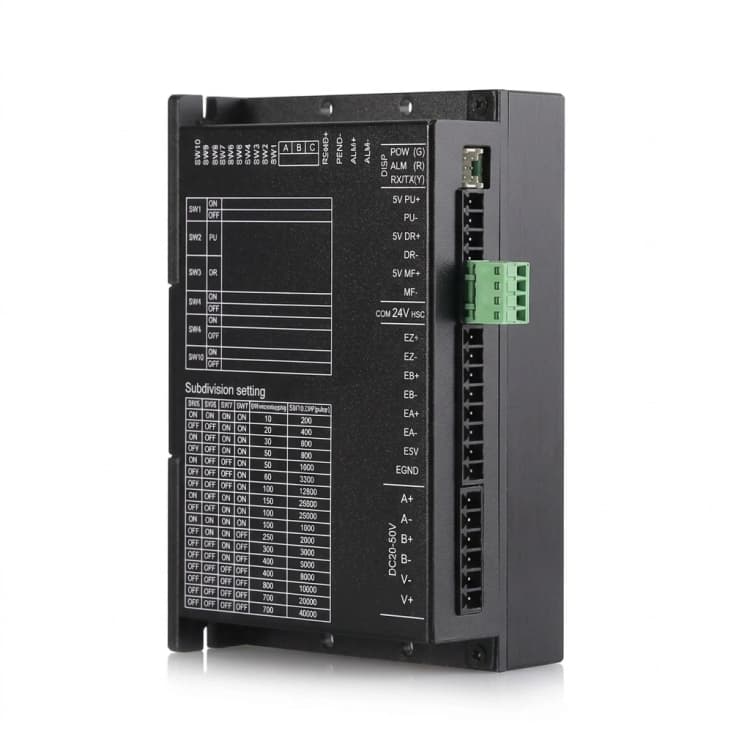
| DM556E class | 18-50 V input (manual), 20-50 V listed on product pages | up to ~5.6 A peak | 16 settings; manual lists 200-51,200 pulses/rev | Pulse width >= 2.5 us; DIR lead >= 5 us; pulse input up to 200 kHz | Preferred when NEMA 23/24 current demand and thermal stress are high. |
| Risk | Probability | Impact | Mitigation Action |
|---|---|---|---|
| Pulse-budget overrun | Medium to High | Missed steps, unstable direction changes, random stalls | Reduce microstep or speed demand, improve controller timing, verify with oscilloscope under full cable load. |
| Thermal overload at high current | Medium | Driver protection trips and production downtime | Enforce ventilation design, use current derating, and run 30-60 minute thermal plateau tests. |
| False accuracy confidence from high microstep | Medium | Process drift despite smooth motion profile | Validate repeatability on loaded mechanics, not only no-load bench traces. |
| Driver-class under-selection | Medium | Insufficient current/voltage headroom at target speed | Select driver by current-voltage envelope first, then by feature set. |
| EMI-induced pulse corruption | Low to Medium | Intermittent step loss difficult to reproduce | Use differential signaling where needed, grounding discipline, and cabinet routing rules. |
| Decision Item | Status | Why Uncertain | Minimum Action |
|---|---|---|---|
| Exact torque derating curve for your motor at selected voltage and speed | Pending confirmation (公开数据不足) | Public datasheets vary by winding, test method, and ambient setup; cross-vendor reuse is unreliable. | Request motor-specific torque-speed and thermal data, then validate with your own load profile. |
| True controller jitter under production firmware load | Pending confirmation (暂无统一公开阈值) | Bench demos often ignore real control-task jitter and communication overhead. | Measure pulse jitter and DIR timing while full firmware stack is active. |
| Long-cable EMI impact on STEP/DIR edges and interpolation quality | 环境相关,需实测 | TMC2209 documentation explicitly warns that long-cable signals may require filtering or differential transmission. | Execute EMC-minded commissioning with worst-case cable path and load switching conditions. |
| Sustained thermal plateau at full duty cycle | Pending confirmation (场景差异大) | Vendor ambient/cooling rules are model-specific; short bench snapshots cannot replace duty-cycle thermal plateau data. | Run at least 30-minute screening and 60-minute worst-case thermal tests with acceptance limits. |
| DM556E resolution mapping across hardware/firmware revisions | Pending confirmation (公开资料表述不完全一致) | Public material lists 200-51,200 pulse/rev capability, but exact DIP/software mapping can vary by revision. | Capture the exact model code, firmware revision, and switch table from supplier before freezing BOM. |
Each example includes premise, process, and outcome so cross-team reviewers can map recommendations into execution checkpoints.
| Scenario | Premise | Process | Outcome |
|---|---|---|---|
| Optics stage with 1.8° NEMA 17 | Need smoother low-speed movement and quiet operation | Start at 1/32 on DRV8825 class, check pulse utilization below 60%, and tune acceleration ramps for low resonance. | Smoothness improved without exceeding timing budget; stack accepted after thermal pass. |
| NEMA 23 indexing table | Target throughput increased from 150 RPM to 400 RPM | Pulse demand exceeded practical margin at 1/32, so team dropped to 1/16 and increased bus voltage for torque retention. | Repeatability held while timing margin recovered, reducing field instability risk. |
| Multi-axis OEM cabinet | Long cable runs and variable ambient in production line | Switched from board-level drive to DM542E class, added differential signaling, then repeated worst-case EMI tests. | Intermittent missed steps were eliminated under production routing conditions. |
| High-current packaging axis | Current demand near 4.5 A phase with high duty cycle | DM556E class selected for headroom; thermal plateau validation performed at 60 minutes with forced-air design. | Protection trips disappeared and procurement moved forward with documented cooling constraints. |
Gate rule: blocker and high findings must be zero before handoff to SEO/GEO closure.
| Severity | Finding | Self-Heal Action | Status |
|---|---|---|---|
| Blocker | None after self-heal | N/A | 0 open |
| High | Driver class recommendation did not constrain effective pulse ceiling in tool math | Bound effective pulse ceiling to the minimum of user input, controller ceiling, and selected driver-class ceiling; surfaced the active limiter in result output. | Closed |
| High | Boundary state recovery guidance was not field-specific | Added explicit per-field boundary messages so users can correct invalid ranges without ambiguity. | Closed |
| Medium | Review gate narrative needed stage1c-specific closure details | Updated stage1c gate rows to reflect current self-heal actions and tool-layer risk controls. | Closed |
| Low | Tool result card lacked explicit pulse-limit ownership signal | Added pulse-limiter indicator in result metrics and RFQ handoff payload. | Closed |
Questions are grouped around implementation and procurement risk, not glossary-only definitions.
Inquiry Email