
0.44 = 450/1023 (10-bit) or 1802/4095 (12-bit)
ADC Mapping Is Only the Start
A 0.44 command ratio is meaningful only after confirming firmware scaling, filtering, deadband behavior, and ADC resolution mapping.
Hybrid Tool + Report
Start with the tool to test your command mapping, including the alias-intent query "0.44 adc stepper motor controller". Then use the report layer to verify method, evidence, fit boundaries, tradeoffs, and risk controls before you freeze your driver-motor stack.
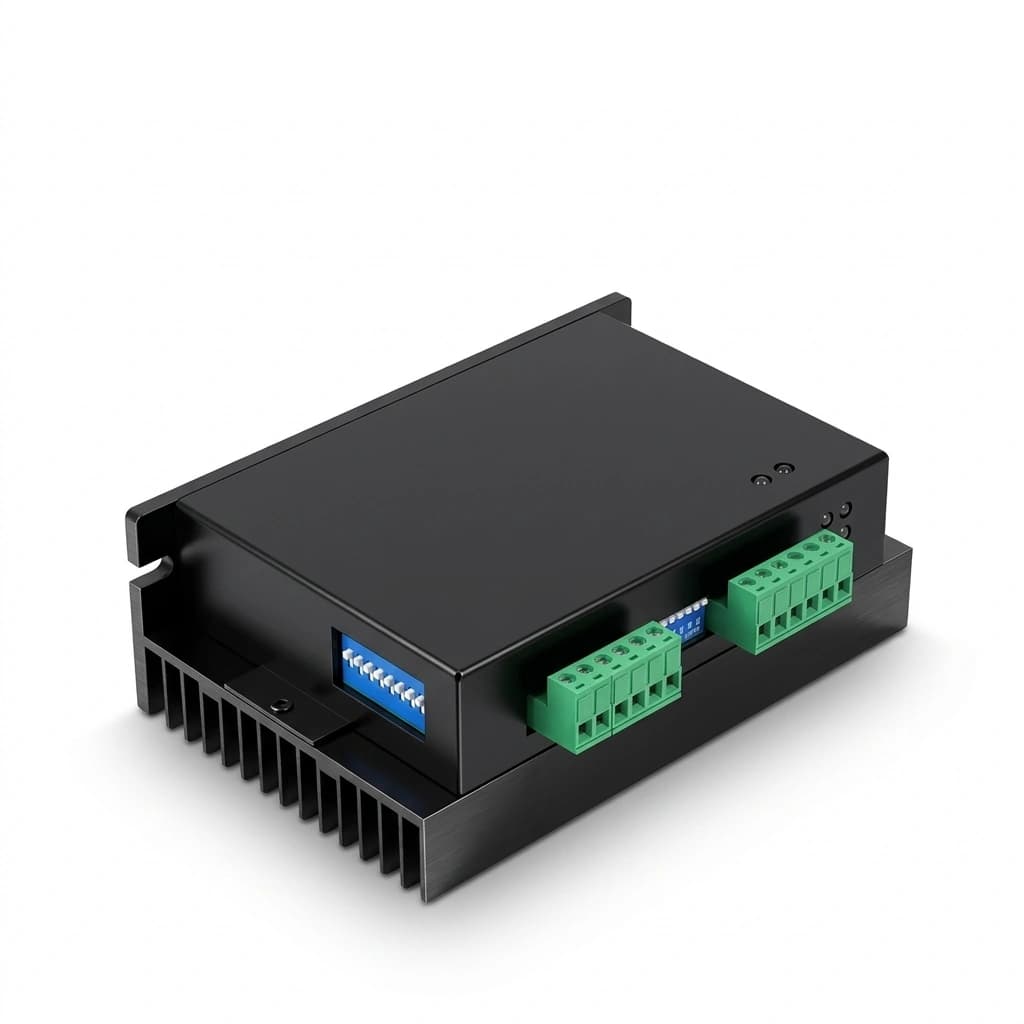
Visible boundary disclosure
This page is for engineering screening and decision support. It does not replace product-level qualification tests under your real duty cycle, ambient conditions, and compliance constraints.
Source refresh timestamp
Evidence references and assumptions were reviewed on 2026-05-12. Time-sensitive values should be rechecked before procurement.
Tool Layer
If your query is "0.44 adc stepper motor controller", start here. The tool converts ADC command ratio into expected RPM and checks pulse, torque, and current margins with explicit next-step guidance.
Use these summary points to decide whether your current control strategy is ready for prototype freeze or still needs architecture changes.
0.44 = 450/1023 (10-bit) or 1802/4095 (12-bit)
ADC Mapping Is Only the Start
A 0.44 command ratio is meaningful only after confirming firmware scaling, filtering, deadband behavior, and ADC resolution mapping.
DRV8825: tWH/tWL >=1.9 us, DM542E: pulse >=2.5 us
Timing Floor Beats Nameplate Frequency
Published STEP/DIR timing minima can dominate stability before you hit nominal pulse-frequency limits.
TI SLVAES8A: use microstepping for smoothness, not as sole accuracy control
Microstepping Smoothness != Absolute Accuracy
Higher microstepping can improve smoothness and noise but does not automatically guarantee final position accuracy under load.
Heuristics only; no universal public standard found
Reserve Thresholds Need Local Validation
1.3x / 1.8x torque reserve and 80% pulse utilization are planning gates; final go/no-go still depends on thermal and disturbance tests.
| Metric | Preferred Band | Warning Band | Why It Matters |
|---|---|---|---|
| ADC command ratio | 0.20-0.80 | <0.05 or >0.95 | Extreme ends often amplify quantization, offset drift, and command clipping behavior. |
| Pulse utilization | <60% | >=80% | Higher utilization leaves less timing margin for PLC jitter and wiring noise; this threshold is heuristic, not a regulatory line. |
| Torque reserve | >=1.3x | <1.0x | Reserve below unity implies direct stall risk under realistic disturbance; 1.3x/1.8x targets are screening heuristics. |
| Current utilization | <75% | >85% | High current fraction raises thermal risk and reduces long-run reliability headroom. |
| Control mode choice | Aligned with error tolerance | Open-loop under strict repeatability | Mode mismatch causes hidden quality cost even if initial bench tests pass. |
This round addresses decision-impacting gaps found in the prior revision. Each row maps one weakness to a concrete, verifiable enhancement so this page adds net-new engineering value.
| Gap Found | Why It Matters | Stage1b Enhancement |
|---|---|---|
| Pulse and timing claims lacked primary-source numeric limits | Users could over-trust a generic 80% warning without checking device-level STEP/DIR constraints. | Added A4988 / DRV8825 / DM542E published timing and frequency boundaries with direct datasheet/manual sources. |
| 0.44 ADC meaning lacked resolution-level boundaries | Teams might treat 0.44 as a fixed hardware value instead of a normalized ratio mapped by ADC depth. | Added quantization mapping table for 10/12/14/16-bit controllers plus LSB ratio and failure implications. |
| Microstepping conclusions lacked explicit counterexample framing | Readers might infer that higher microsteps alone guarantee absolute positioning accuracy. | Linked TI application brief evidence that microstepping improves smoothness but does not automatically ensure final accuracy. |
| Heuristic thresholds could be misread as standards | 1.3x/1.8x reserve and 80% pulse gates could be treated as compliance limits, causing false certainty. | Marked thresholds as engineering heuristics and added a dedicated “public evidence insufficient” boundary item. |
| Segment | Typical Profile | Decision Meaning |
|---|---|---|
| Suitable | Conveyors, indexing tables, low-to-mid speed positioning with moderate disturbance | These scenarios usually benefit from deterministic pulse control and predictable command scaling. |
| Conditionally suitable | High-inertia axes with aggressive acceleration demands | Feasible only with explicit reserve margin, tuned ramps, and robust EMI hygiene. |
| Often not suitable | Ultra-tight dynamic positioning with rapid disturbance rejection requirements | Servo-class response may be more reliable than open-loop stepper control. |
| Not suitable for this tool alone | Safety-critical motion requiring certified fault response | This page is a screening framework and does not replace formal functional safety validation. |
The tool applies deterministic calculations for command RPM, required pulse frequency, torque reserve, and current utilization. Thresholds in this page are practical planning heuristics and must be validated against your machine-level acceptance criteria.
| Evidence Topic | Usable Finding | Source | Checked Date |
|---|---|---|---|
| Microstepping accuracy boundary | TI documents that increasing microstep count can improve smoothness/noise behavior but does not automatically improve absolute position accuracy. | TI Application Brief SLVAES8A (Revised Feb 2026) | 2026-05-12 |
| DRV8825 timing and command-frequency boundary | DRV8825 lists 8.2-45 V operation, up to 1/32 microstepping, 250 kHz step-input support, and explicit STEP/DIR minimum timing requirements. | TI DRV8825 datasheet | 2026-05-12 |
| A4988 pulse-interface floor and microstep limit | A4988 documentation states up to 1/16 microstepping with minimum STEP high/low pulse width and DIR setup/hold timing constraints. | Allegro A4988 datasheet | 2026-05-12 |
| DM542E industrial pulse interface limits | DM542E manual lists 20-50 VDC supply, pulse input up to 200 kHz, minimum pulse width 2.5 us, and DIR setup >= 5 us. | Leadshine DM542E user manual | 2026-05-12 |
| Interpolation and diagnostics boundary in TMC2209 class | TMC2209 provides StealthChop2, StallGuard4 load measurement, and MicroPlyer interpolation up to 256 microsteps from STEP/DIR commands. | ADI/Trinamic TMC2209 datasheet | 2026-05-12 |
| Supply voltage and current role in speed/torque tradeoff | Leadshine guidance states supply voltage primarily affects high-speed performance while output current sets low-speed holding torque capability. | Leadshine DM542E user manual | 2026-05-12 |
| Resonance and acceleration boundary in real stepper systems | Practical stepper behavior remains sensitive to resonance zones and acceleration profiling; pulse-command equations alone are not enough for acceptance. | Oriental Motor stepper motor basics | 2026-05-12 |
This alias is handled on the same canonical page to avoid duplicate-route conflict. The table below shows how a 0.44 command ratio maps into motion command values in a common 300 RPM control range example.
| ADC Ratio | Command RPM | Pulse @ 1.8°, 16x | Practical Meaning |
|---|---|---|---|
| 0.10 | 30 RPM | 160 Hz | Low-speed tuning zone; check for resonance and stick-slip behavior. |
| 0.25 | 75 RPM | 400 Hz | Common commissioning band for early load tests. |
| 0.44 | 132 RPM | 704 Hz | Alias-intent point: usually safe pulse demand on industrial drives, but verify torque reserve and thermal margins. |
| 0.60 | 180 RPM | 960 Hz | Good mid-high throughput for many NEMA 23 systems with proper voltage. |
| 0.80 | 240 RPM | 1280 Hz | Check acceleration ramps and cable integrity before scaling production speed. |
| 1.00 | 300 RPM | 1600 Hz | Full-range command. Validate overshoot, thermal behavior, and duty-cycle repeatability. |
If your firmware uses nonlinear command mapping, replace this linear table with measured ADC-to-speed points and rerun the tool with measured values.
| Controller ADC Depth | Full-Scale Code | 0.44 Code Value | 1 LSB Ratio | Boundary Meaning |
|---|---|---|---|---|
| 10-bit ADC | 1023 | 450 | 0.0978% | At 10-bit depth, one LSB is relatively coarse. Small analog noise can visibly move command RPM near low-speed zones. |
| 12-bit ADC | 4095 | 1802 | 0.0244% | Common PLC/MCU depth for smoother command mapping. Still validate offset and gain drift after thermal soak. |
| 14-bit ADC | 16383 | 7209 | 0.0061% | Finer code granularity reduces quantization contribution but does not remove EMI or ground-reference error. |
| 16-bit ADC | 65535 | 28835 | 0.0015% | Very fine ratio steps. Real benefit depends on end-to-end noise floor and controller filtering behavior. |
Code values use nearest-integer rounding of (full scale × 0.44). If your firmware applies filtering or deadband, validate effective command output with logged raw ADC streams.
Use this table to translate abstract “pulse ceiling” assumptions into datasheet-level timing constraints before final parameter freeze.
| Driver Class | Published Boundary | Engineering Meaning |
|---|---|---|
| A4988 class (Allegro) | VMOT 8-35 V, up to 1/16 microstep, STEP high/low >= 1.0 us, DIR setup/hold >= 200 ns. | Good for low-cost prototyping, but timing and thermal headroom can be the first bottleneck in dense cabinets. |
| DRV8825 class (TI) | VM 8.2-45 V, up to 1/32 microstep, step-input frequency up to 250 kHz, STEP high/low >= 1.9 us, DIR setup/hold >= 650 ns. | Higher microstep depth and known timing limits help planning, but real margin still depends on cable quality and jitter. |
| DM542E class (Leadshine) | 20-50 VDC supply, pulse input up to 200 kHz, minimum pulse width 2.5 us, minimum DIR setup 5 us. | Industrial envelope is robust, but PLC output timing must be checked with oscilloscope traces, not assumptions. |
| TMC2209 class (ADI/Trinamic) | 2-phase driver with StealthChop2, StallGuard4, and MicroPlyer interpolation up to 256 microsteps from STEP/DIR input. | Useful when acoustic/noise behavior matters, but interpolation and diagnostics do not replace full load validation. |
| Option | Voltage Band | Control Depth | Tradeoff |
|---|---|---|---|
| Logic-level module (A4988/DRV8825 class) | 8-45 V | STEP/DIR, 1/16 to 1/32 microstep class | Fastest prototype path with strict timing/thermal boundaries. Use only when command jitter and cabinet EMI are controlled. |
| Digital industrial drive (DM542E class) | 20-50 V | Industrial STEP/DIR + configurable microsteps + explicit timing specs | Balanced for many NEMA 23 builds, but you must confirm pulse width and DIR setup on your real PLC output. |
| High-voltage drive (DMA860E class) | 30-110 V | Higher-speed torque retention | Can retain torque deeper into high-speed bands, but insulation, grounding, and safety reviews become stricter. |
| Closed-loop hybrid stepper | 20-80 V | Encoder feedback with step-loss visibility | Better observability and repeatability with higher BOM and tuning burden; still requires thermal and disturbance validation. |
| Servo architecture | Wide by platform | High dynamic response and fault handling | Best response and disturbance rejection, but integration and cost are usually highest. |
| Risk | Probability | Impact | Mitigation Action |
|---|---|---|---|
| Command scaling mismatch between ADC and firmware units | Medium | High | Lock one transfer function document and validate with logged command-response points before release. |
| Pulse timing jitter near controller ceiling | Medium | High | Hold pulse utilization below planning threshold and verify STEP high/low plus DIR setup/hold against selected driver datasheet. |
| Thermal drift reducing torque margin | High | High | Run 30-60 minute thermal soak and include ambient worst-case acceptance limits. |
| Open-loop step loss under acceleration disturbances | Medium | Medium | Increase reserve ratio, tune ramps, and switch to closed-loop hybrid when repeatability is critical. |
| Procurement drift to unmatched drive family | Medium | Medium | Freeze voltage/current/command constraints in RFQ and reject alternatives without equivalent evidence. |
| Heuristic thresholds treated as compliance standards | Medium | High | Label 80% and 1.3x/1.8x as planning heuristics in specs, then bind final acceptance to measured thermal, torque, and repeatability tests. |
| Decision Item | Status | Why Uncertain | Minimum Action |
|---|---|---|---|
| Long-term drift of ADC offset under production EMI conditions | Pending measurement | Public docs describe interface requirements but do not capture your wiring topology and cabinet interference. | Record ADC raw values and commanded RPM over full duty cycle on production-equivalent wiring. |
| Axis-specific torque reserve after thermal equilibrium | Public evidence insufficient | Catalog torque values are often room-temperature references without enclosure derating. | Measure pull-out margin after 60-minute soak at worst-case ambient and duty cycle. |
| Repeatability after wear and backlash growth | Pending confirmation | Wear progression is application-specific and rarely transferable from generic public references. | Define end-of-life repeatability criteria and require supplier durability traceability data. |
| Universal standard for 80% pulse or 1.3x reserve thresholds | No reliable public standard found | These numbers are widely used engineering heuristics, but no single public regulatory document defines them as mandatory limits. | Document them as internal screening gates only, and tie release decisions to measured acceptance data. |
Each scenario includes premise, process, and outcome so technical and sourcing teams can map recommendations into execution checkpoints.
| Scenario | Premise | Process | Outcome |
|---|---|---|---|
| Packaging indexer retrofit | Legacy analog knob replaced by PLC ADC command | Calibrate 0.44 ratio to mid-rate throughput, verify pulse jitter at cabinet temperature, then run 8-hour continuity test. | Stable production achieved after reducing maximum command map and adding acceleration ramp constraints. |
| Valve positioning station | Long dwell with occasional reversals under warm ambient | Use closed-loop hybrid shortlist, enforce 1.8x reserve target, run 60-minute thermal plateau validation. | Step-loss incidents dropped after moving from open-loop to closed-loop with conservative current settings. |
| CNC accessory axis | Need higher speed while preserving repeatability | Compare mid-voltage vs high-voltage drive classes and observe pulse integrity at full cable length. | High-voltage class selected after repeatability improved at target speed band. |
| OEM multi-site deployment | Same software profile planned for multiple machines | Freeze shared baseline then run per-site calibration for ADC offset and thermal behavior. | Reduced field variance by treating commissioning as site-specific, not purely firmware-generic. |
Questions are organized around implementation risk and procurement decisions, not glossary-only definitions.
Inquiry Email