
holding torque must clear load x safety factor
12 Nm is a supplier-fit threshold, not a final sizing result
The page begins with the checker because a 12 Nm label only becomes useful after load torque, speed, bus voltage, and duty cycle are visible.
Tool Layer
Enter torque, speed, current, bus voltage, and application constraints. Start with the core inputs below; advanced assumptions use visible defaults and can be adjusted after the first result.
Result feedback: waiting for supplier inputs
Run the checker to generate an open-loop, closed-loop, brake-review, or servo/gearbox RFQ path.
Boundary notes: this tool screens supplier fit and RFQ evidence. It does not replace final motor sizing, risk assessment, safety review, or machine validation. Public 24-80 VDC driver examples do not validate a different high-voltage drive class.
Empty state: run the checker to decide whether your 12 Nm project should start with open-loop NEMA 34 sourcing, a closed-loop kit, encoder + brake review, or servo/gearbox comparison.
Advanced assumptions
Defaults are visible for first-pass RFQ screening. Adjust them when you know the real current, bus voltage, axis count, ambient, and application context.
Report Layer
The checker handles the immediate supplier decision. The report below explains why the result is trustworthy, where it can fail, and which documents should close the RFQ before purchase order release.
Visible sizing boundary
This page screens supplier fit and RFQ evidence. It is not a final motor-sizing approval, safety assessment, or machine validation procedure.
SERP and source refresh timestamp
Search intent and public evidence were reviewed on 2026-06-16. Recheck supplier documents, stock, and certificates before purchase order release.
The practical answer is not "buy any 12 Nm stepper." The first decision is which supplier path has enough torque, speed, thermal, and recovery evidence for your machine.
holding torque must clear load x safety factor
12 Nm is a supplier-fit threshold, not a final sizing result
The page begins with the checker because a 12 Nm label only becomes useful after load torque, speed, bus voltage, and duty cycle are visible.
86 mm frame, often 1.8 deg, 4 or 8 leads
Most visible results cluster around NEMA 34 products
Current SERP patterns show open-loop motors, closed-loop kits, brake variants, and driver bundles rather than one universal supplier class.
pull-out curve beats title torque
Speed-torque proof is the deciding document
Oriental Motor documentation states that exceeding the pull-out torque curve causes loss of synchronism, so supplier quotes need curve evidence at your speed.
encoder + matched drive lowers missed-step risk
Closed-loop belongs in the shortlist when downtime matters
Public CL86T documentation lists closed-loop behavior, 24-80 VDC input, up to 8.2 A peak, and 200 kHz pulse input as an example evidence package.
vertical load, tight margin, high inertia
Brake and servo alternatives are boundary controls
If the tool returns a boundary result, the next action is not guessing a bigger catalog motor. Compare brake, larger frame, gearbox, and servo options with supplier engineering.
| Metric | Public Data Point | Decision Meaning |
|---|---|---|
| Common public product cluster | NEMA 34 / 86 x 86 mm high-torque motors | Use frame and stack length as a starting filter, then verify winding and curve data. |
| Typical 12 Nm examples | 12 Nm / about 1700 oz-in holding torque | Treat holding torque as static capability, not moving torque at RPM. |
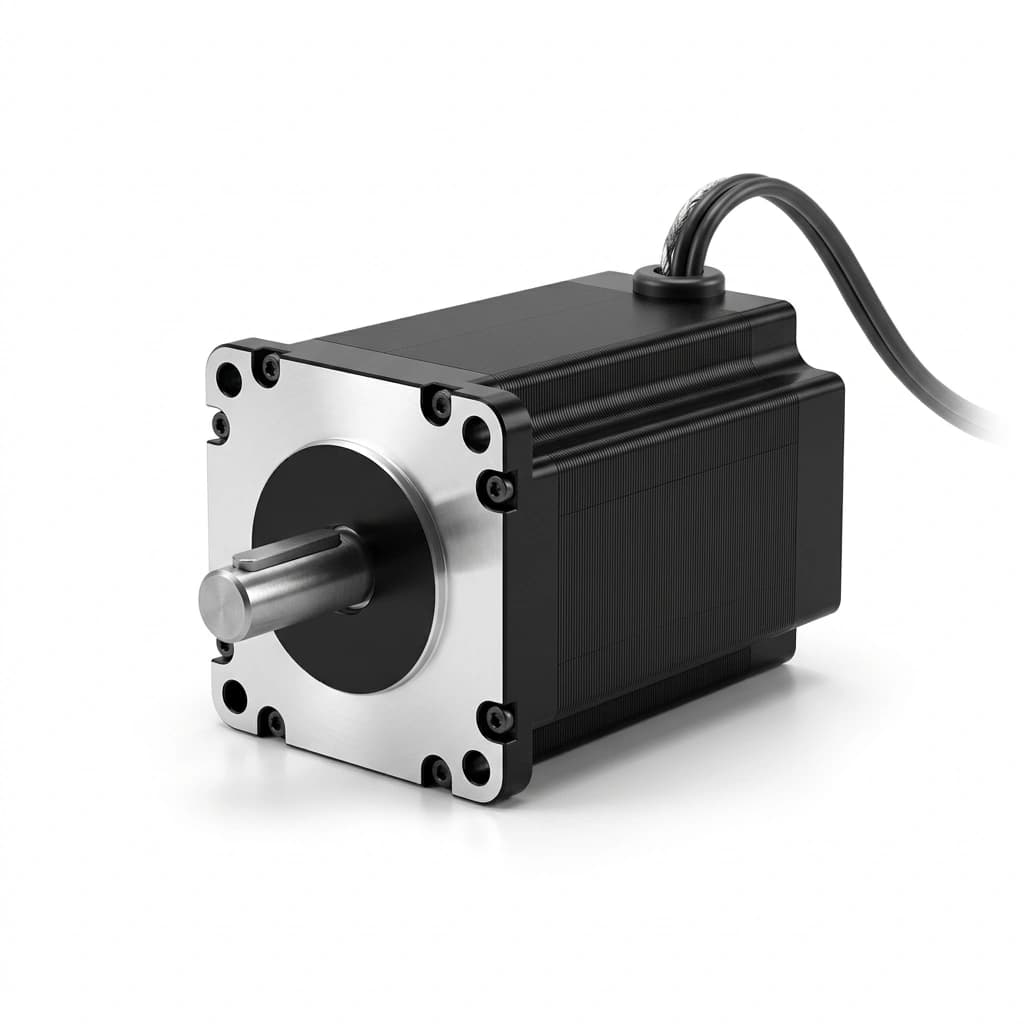
| Open-loop product example | 34IP65-120: 1.8 deg, 6.0 A/phase, 0.72 ohm, 7.3 mH, 86 x 86 x 164.5 mm, 5.0 kg | Use exact model data, not the search title, when comparing supplier quotes. |
| Driver evidence example | CL86T V3.0: 24-80 VDC input, 30-72 VDC recommended supply, 8.2 A peak, 200 kHz pulse input | Closed-loop kits should quote drive voltage, current, encoder, pulse-interface limits, and over-voltage behavior together. |
| Thermal boundary example | -20C to +50C ambient, 80C max rise in public NEMA 34 specs | Hot cabinets need derating and thermal soak evidence instead of catalog-only approval. |
The page keeps the immediate checker and deeper sourcing report on one URL because the keyword can mean both "find a supplier" and "prove the supplier path is safe enough to quote."
| Decision Gap | Impact | Page Response |
|---|---|---|
| Search intent could be read as a pure supplier list | A thin list would not help the buyer decide whether open-loop, closed-loop, brake, or servo review is the right RFQ path. | The first-screen checker returns a procurement path, margin metrics, assumptions, and RFQ next action before the long report begins. |
| Holding torque can be overclaimed | Buyers can select a 12 Nm title without checking moving torque at speed. | Speed-torque source notes, derating logic, and evidence gates require pull-out curves before supplier approval. |
| Public results include mixed product classes | Bare motors, closed-loop kits, brake variants, and driver bundles are not directly comparable. | The SERP pattern table, supplier path comparison, and PO-release gates separate each product class before quotes are compared. |
| Unavailable public facts need visible limits | The page could accidentally imply market share, lead-time, or compliance certainty. | The known-unknown table and quote-specific confirmation language keep uncertain claims out of the recommendation. |
| Driver voltage and current limits need model-specific evidence | A buyer could apply a 24-80 VDC closed-loop driver example to a higher-voltage quote without checking the drive manual. | CL86T source limits, the high-voltage substitution boundary, and the driver-fit evidence gate keep drive classes separate. |
| Compliance and machine-safety claims need sharper boundaries | CE, RoHS, IP rating, brake, and vertical-axis claims can be mistaken for complete system approval. | The standards boundary table covers EU CE, RoHS, IP rating, machine guarding, and quote-scope actions without implying final approval. |
The page is intentionally not a generic motor guide, not a 120V voltage page, and not a precision step-angle page. It serves the high-torque supplier qualification query.
| SERP Pattern | Likely Need | This Page Responds By |
|---|---|---|
| Open-loop 12 Nm motor listing | Confirm whether a high-torque NEMA 34 motor is physically and electrically suitable. | The checker tests torque margin and routes wide-margin cases to open-loop RFQ. |
| Closed-loop 12 Nm kit | Reduce missed-step risk and get a matched drive, encoder, cable, and motor package. | The checker routes medium-risk, multi-axis, or higher-speed projects to closed-loop kit review. |
| Brake or vertical-load variant | Hold position safely during power loss or vertical-axis operation. | Boundary logic escalates brake and vertical axes to supplier engineering review. |
| Generic supplier page or marketplace result | Avoid thin claims and identify which evidence matters before purchase. | The report layer provides source-backed data, unknowns, risks, and PO-release gates. |
The tool returns a deterministic screening result. The report layer explains why the output is only as strong as the curve, driver, thermal, and supplier evidence behind it.
| Method Step | Calculation / Logic | Output |
|---|---|---|
| 1. Classify the supplier object | Separate bare motor, closed-loop kit, brake package, and servo/gearbox alternative before comparing quotes. | A comparable supplier path instead of mixed listings. |
| 2. Calculate required static torque | Required torque = estimated load torque x safety factor. | Static margin against the 12 Nm holding-torque target. |
| 3. Apply speed and voltage derating | Higher RPM and lower bus voltage reduce first-pass moving-torque confidence. | Estimated moving-torque margin for RFQ triage. |
| 4. Gate high-risk contexts | Vertical load, brake requirement, tight margin, hot cabinet, and multi-axis power move the result to engineering review. | Controlled boundary state with a minimum executable RFQ path. |
| 5. Convert result into supplier evidence | Each result asks for motor datasheet, speed-torque curve, matched drive, thermal data, cable set, and lead-time validity. | A supplier-ready quote request. |
Keep bare motors, closed-loop kits, brake variants, and servo alternatives from competing as if they were the same product.
| Path | Best For | Ask Supplier For | Watch Out |
|---|---|---|---|
| Open-loop NEMA 34 motor | Wide torque margin, lower consequence of missed steps, simpler CNC or fixture axes. | 12 Nm motor datasheet, winding data, torque-speed curve at selected voltage, matching drive, sample lead time. | No position correction; missed steps may not be detected until the part or machine shows an error. |
| Closed-loop 12 Nm kit | Higher speed, tighter uptime expectations, gantry axes, and applications where recovery matters. | Encoder resolution, matched drive manual, alarm outputs, pulse input limits, cable lengths, and tuning notes. | Feedback does not remove the need for torque margin, power sizing, and thermal validation. |
| Encoder + brake package | Vertical axes, holding loads, power-loss exposure, and machines that need controlled stop behavior. | Brake torque, release voltage, wiring diagram, safe-state behavior, heat rise, and brake life assumptions. | A brake is a holding device, not a substitute for proper motion sizing or safety design. |
| Servo or gearbox alternative | High speed, high inertia, tight cycle time, continuous duty, or poor stepper torque margin. | Inertia ratio, continuous/peak torque, gearbox efficiency, backlash, drive interface, and costed comparison. | Higher component cost may be justified if it avoids repeated missed-step and overheating failures. |
Use the matrix to decide when a cheaper open-loop motor is enough and when the safer RFQ path should include feedback, brake, or servo comparison.
| Dimension | Open Loop | Closed Loop | Brake Package | Servo / Gearbox |
|---|---|---|---|---|
| Quote speed | Fast when catalog stock exists | Medium; kit matching and cable details matter | Slower; brake and safe-state details require review | Slower; deeper application sizing needed |
| Missed-step visibility | Low | High with encoder alarm / correction | High when paired with feedback | High with servo feedback |
| Thermal risk | Medium to high if current stays high at standstill | Medium; current can be more controlled but still heats | Medium; brake heat and duty add checks | Application-specific; often better at high speed |
| Cost complexity | Lowest typical BOM complexity | Moderate kit cost and documentation | Higher hardware and wiring complexity | Highest typical qualification effort |
| Best procurement fit | Prototype, router, and low-consequence axes | Production axes with uptime concern | Vertical or holding-load axes | High-speed or high-inertia axes |
Public pages support the product-class and evidence-gate logic. They do not prove availability, compliance, or fit for a specific machine.
| Topic | Finding | Source | Checked |
|---|---|---|---|
| SERP product pattern | StepperOnline category snippets show NEMA 34 12.0 Nm motors such as 34HE59-6004S and 34HP59-6004S with 1.8 deg step angle, 6.0 A/phase, and about 86 x 86 x 150 mm class dimensions. | StepperOnline NEMA 34 category snippets | 2026-06-16 |
| Exact 12 Nm product example | StepperOnline 34IP65-120 lists 12 Nm holding torque, 1.8 deg step angle, 6.0 A/phase, 0.72 ohm resistance, 7.3 mH inductance, 86 x 86 mm frame, 164.5 mm body length, 14 mm shaft, IP65 rating, and 5.0 kg weight. | StepperOnline 34IP65-120 product page | 2026-06-16 |
| Closed-loop and brake variants | Public results include NEMA 34 closed-loop 12 Nm products with encoder and electromagnetic brake variants, showing the keyword is not limited to bare motors. | StepperOnline / Oyostepper public result snippets | 2026-06-16 |
| Driver class example | CL86T V3.0 manual lists 24-80 VDC input, 30-72 VDC recommended supply headroom, up to 8.2 A output current, 200 kHz pulse input frequency, and 0-50C ambient for a closed-loop stepper driver. | StepperOnline CL86T V3.0 manual | 2026-06-16 |
| NEMA 34 torque range example | LAM Technologies describes NEMA 34 86 x 86 mm motors with holding torque up to 12 Nm and 8-wire connection choices for bipolar or unipolar use. | LAM Technologies NEMA 34 product page | 2026-06-16 |
| Thermal and mechanical specifications | ATO NEMA 34 specifications list examples with 12.0 Nm torque, around 5.0-6.2 A current, temperature rise up to 80C, and ambient range of -20C to +50C. | ATO NEMA 34 stepper motor specs PDF | 2026-06-16 |
| Speed-torque boundary | Oriental Motor states that the pull-out torque curve is the maximum torque at a given speed, and exceeding it causes loss of synchronism. | Oriental Motor speed-torque curve guide | 2026-06-16 |
| Drive choice changes torque curve | Oriental Motor notes that once a stepper motor is running, torque depends on drive type and voltage, and the same motor can have different speed-torque curves with different drivers. | Oriental Motor angle-torque characteristics | 2026-06-16 |
| EU CE responsibility boundary | EU guidance states that the manufacturer identifies applicable EU requirements, gathers technical documentation, and drafts and signs the EU Declaration of Conformity; a listing claim alone is not enough for system approval. | Your Europe CE marking guidance | 2026-06-16 |
| RoHS scope boundary | The European Commission describes RoHS as EU rules restricting hazardous substances in electrical and electronic equipment to protect environment and public health. | European Commission RoHS Directive page | 2026-06-16 |
| Machine safety boundary | OSHA 29 CFR 1910.212 requires machine guarding methods to protect operators and employees from hazards created by machine operation; motor or brake selection does not replace machine-level risk controls. | OSHA 1910.212 machine guarding rule | 2026-06-16 |
Public Evidence Limits
The sources above support screening logic, not final supplier approval. Require current supplier quotes, model manuals, certificates, lead-time validity, and machine-specific test evidence before purchase release.
These boundaries stop supplier claims from being treated as complete machine approval. They are procurement gates, not legal advice.
| Boundary | What Public Evidence Supports | Quote Action |
|---|---|---|
| CE / EU Declaration of Conformity | CE marking is a manufacturer responsibility under applicable EU product rules. The supplier should provide a signed declaration, applicable directives or regulations, and supporting technical documentation owner. | Do not accept a logo screenshot. Request model number, manufacturer name/address, directive list, standards used, signature date, and importer responsibility. |
| RoHS for electrical and electronic equipment | RoHS scope is material and product-category dependent. Motor, driver, cable, brake, and encoder accessories may need separate supplier declarations. | Request RoHS statement by exact model and revision, then confirm whether cable sets and substituted components are included. |
| IP rating and environment | A public IP65 motor listing can show a rated motor body, but does not automatically validate shaft seal, connector, brake, encoder, cable exit, or installed enclosure. | Ask for the IP-rated assembly drawing, connector/cable limits, cleaning method limits, and whether brake or encoder variants keep the same rating. |
| Machine guarding and vertical loads | Safety exposure is machine-level. A brake, encoder alarm, or closed-loop driver cannot by itself prove compliance for a vertical or hazardous axis. | Add safe-state logic, guarding or other risk controls, power-loss test results, and documented acceptance criteria to the validation plan. |
| High-voltage drive substitution | The cited CL86T example is a 24-80 VDC driver with 30-72 VDC recommended supply headroom. Higher-voltage quotes are a different evidence package. | Require the exact drive manual, insulation and protection ratings, braking resistor guidance, cabinet clearance, and matched speed-torque curve. |
This gate converts the report into purchase controls. A supplier that cannot clear these gates may still be useful for prototypes, but should not be treated as validated for production release.
| Gate | Evidence to Accept | Reject / Escalate |
|---|---|---|
| Motor identity | Exact model, frame, stack length, shaft, step angle, lead count, current, resistance, inductance, and torque rating. | Title says 12 Nm but datasheet cannot be matched to the quoted model. |
| Speed-torque evidence | Curve for the quoted motor and driver voltage, with target RPM and load torque inside the usable envelope. | Only holding torque is supplied, with no moving-torque evidence. |
| Driver fit | Drive input voltage, recommended supply headroom, current setting method, RMS/peak meaning, pulse limit, protection features, and wiring manual. | A generic 6 A, 80 V, or 110 V claim with no matched-drive documentation. |
| Thermal and duty cycle | Temperature-rise limit, ambient rating, duty cycle, cooling assumptions, and derating instructions. | Supplier assumes room-temperature intermittent use for a warm production cabinet. |
| Environmental and compliance scope | IP rating, CE/RoHS or local compliance documents, certificate scope, cable/connector limits, and installation exclusions tied to the exact quoted model. | A public listing badge or generic certificate that does not name the motor, driver, brake, encoder, or cable revision. |
| PO release package | Lead time, warranty, cable set, substitution policy, certificates, sample plan, and revision lock. | Marketplace cart or sales email without revision and substitute controls. |
These risks are the most likely to turn a simple 12 Nm supplier quote into a late engineering change.
| Risk | Probability | Impact | Mitigation |
|---|---|---|---|
| Holding torque overread | High | A 12 Nm title is treated as available torque at operating speed. | Require pull-out torque curve at the selected driver voltage and target RPM. |
| Driver current mismatch | Medium | Drive overheats, trips, or under-drives the motor. | Confirm RMS vs peak current, current setting table, heat-sink temperature, and supplier-approved motor pair. |
| Vertical-axis drift | Medium | Load drops or moves during power loss. | Add brake review, safe-state logic, anti-drop validation, and mechanical risk controls. |
| Multi-axis supply sag | Medium | Voltage dip, nuisance alarms, or lost torque during acceleration. | Size supply by bus voltage, axis count, duty, acceleration, and diversity assumptions. |
| Thermal under-validation | Medium | Motor or drive runs hot in the real cabinet. | Run thermal soak at ambient, current setting, duty cycle, and enclosure airflow matching the machine. |
| Supplier substitution | Medium | Similar-looking product ships with different winding, cable, encoder, or driver revision. | Freeze exact model, revision, cable set, firmware/manual version, and accepted substitutes in the PO. |
| Compliance badge overread | Medium | A buyer assumes a marketplace badge proves the complete motor-drive-brake-cable package is acceptable in the destination market. | Request exact declarations, certificate scope, standards list, model revisions, and importer responsibilities before PO release. |
These claims stay unproven until supplier quotes, documents, and application tests close them.
| Unknown | Status | Minimum Action |
|---|---|---|
| Global market share by 12 Nm supplier | No reliable public dataset | Do not rank suppliers by claimed popularity; compare evidence package and delivery validity. |
| Universal lead-time premium for closed-loop vs open-loop | Quote-specific | Request dated stock, sample, and production lead-time commitments from each supplier. |
| Compliance sufficiency of a public listing | Quote-specific | Ask for exact certificate scope, declaration, manual revision, and installation exclusions. |
| Whether IP65 survives the installed cable and brake/encoder variant | To confirm / public listing is not enough | Request assembly-level IP evidence, cable gland/connector data, and variant-specific drawings. |
| Application-specific torque margin threshold | Engineering-specific | Set acceptance criteria from failure consequence, duty cycle, inertia, and test results. |
Use these as pattern matches for early RFQ routing. Exact model selection still depends on your load, duty cycle, and validation plan.
CNC router Z axis upgrade
Premise: 12 Nm target, vertical load, moderate speed, and high damage risk if the axis drops.
Process: Checker routes to encoder + brake supplier review with safe-state and brake evidence.
Outcome: RFQ compares closed-loop brake kit against servo/gearbox alternative instead of a bare motor listing.
Gantry X axis replacement
Premise: Wide static margin but two synchronized axes and higher target speed.
Process: Checker routes to closed-loop kit, then report gates require matched drive and alarm behavior.
Outcome: Procurement requests cables, encoder, drive manual, and speed-torque proof in one quote.
Rotary indexing fixture
Premise: High holding torque, low speed, lower consequence of missed steps, and enough safety factor.
Process: Checker allows open-loop shortlist with torque-speed and thermal evidence as PO gates.
Outcome: Buyer avoids overspending on servo while still requiring real curve data.
High-inertia belt conveyor
Premise: Large inertia, acceleration-heavy cycle, and target speed above comfortable stepper margin.
Process: Boundary result moves the discussion to servo or gearbox comparison.
Outcome: Supplier quote includes inertia ratio and continuous/peak torque instead of only NEMA 34 catalog torque.
These internal references cover related sizing and procurement work without splitting this 12 Nm supplier intent into competing pages.
Use this as a final scan before turning the page output into a supplier email or purchase-control checklist.
| Area | Risk Controlled | Release Check | Status |
|---|---|---|---|
| Tool-first task flow | Supplier fit could be hidden under long report content. | The first screen is the checker itself, with result feedback, reset control, and RFQ review CTA before the long report begins. | Ready |
| Sizing boundary | A 12 Nm result could be mistaken for final motor sizing. | Boundary disclosure, moving-torque warning, source notes, and FAQ language limit the tool to supplier triage. | Ready |
| Keyword focus | The page could overlap with voltage or precision-step pages. | Focused structure on high-torque NEMA 34 supplier fit, torque margin, closed-loop/brake paths, and RFQ evidence. | Ready |
| Visual evidence | Dense tables alone could slow buyer comprehension. | Encoded SVG torque path, supplier evidence flow, comparison matrix, and risk map support the tables. | Ready |
| Next action clarity | Readers could finish the report without a practical RFQ path. | FAQ and CTA copy cover torque, speed, driver, brake, supplier evidence, and RFQ review actions. | Ready |
Send the tool result with motor constraints, load torque, speed, inertia, duty cycle, driver voltage, axis count, and target lead time. We will help convert the supplier path into a practical quote package.
Inquiry Email