
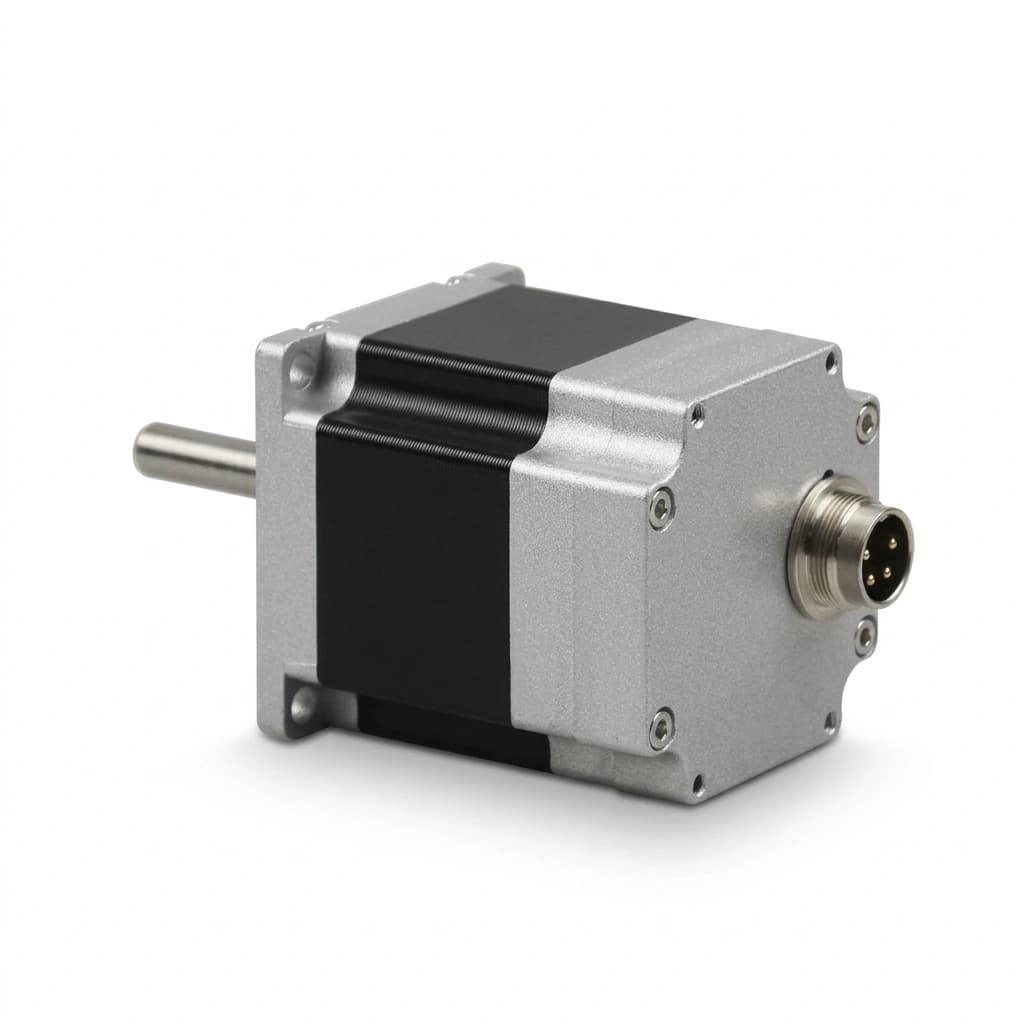
IP65 vs IP67 Waterproof Stepper Motors: OEM Selection Guide
How to specify waterproof NEMA stepper motors for harsh environments without overpaying. Covers shaft seals, thermal derating, and cable traps.
"We bought an IP65 stepper motor, but water still got inside within a week. What happened?"
This is one of the most common complaints we hear from engineering teams designing automated machinery for food processing, outdoor robotics, or CNC machines operating with heavy coolant mist. The assumption is often that specifying "IP65" on a purchase order guarantees a motor that can be blasted with a hose or survive in a damp basement. In reality, purchasing a waterproof NEMA stepper motor requires understanding the distinct boundaries of ingress protection, the mechanical vulnerabilities of the motor shaft, and the hidden thermal penalties of sealing a motor.
A standard NEMA 17 or NEMA 23 stepper motor is completely open to the environment. Dust, oil mist, and water can easily enter through the bearing shields, the gaps in the laminations, or the lead wire exits. When these contaminants mix with the magnetic field and the high-frequency switching currents inside the motor, they cause rapid insulation breakdown, bearing seizure, and ultimate failure.
To prevent this, manufacturers offer IP65, IP67, and even IP69K rated motors. However, moving from a standard open motor to a sealed, harsh-environment motor changes the cost structure, the thermal dynamics, and the mounting requirements of your system. This guide breaks down exactly how to specify and purchase waterproof stepper motors for OEM applications.
Selection scope, reviewed 2026-06-24: This guide is for OEM engineers and buyers specifying NEMA 17, NEMA 23, and similar hybrid stepper motors for splash, coolant mist, rain, and washdown exposure. It does not replace a supplier's certified IP test report, ATEX/IECEx review, chemical compatibility test, or continuous-submersion design validation. If you are still deciding the motor frame size, start with our NEMA 17 vs NEMA 23 selection guide; if heat is already the design constraint, pair this guide with stepper motor thermal management for OEM machine builders.
1. Decoding IP Ratings for Stepper Motors
The International Electrotechnical Commission (IEC) standard 60529 defines Ingress Protection (IP) ratings. The first digit represents protection against solid objects (like dust), and the second digit represents protection against liquids (like water). High-pressure, high-temperature washdown claims such as IP69K/IPx9 should be checked against the supplier's test declaration and the applicable ISO 20653 or IEC test method, not treated as a generic "better IP67."
For industrial stepper motors, anything below IP65 is generally unsuitable for true harsh environments. Here is how the standard ratings map to actual operating conditions on the factory floor:
| IP Rating | Dust Protection (First Digit: 6) | Water Protection (Second Digit) | Real-World Application Equivalent | NEMA Enclosure Equivalent (Approx) | Typical OEM Cost Premium vs Standard |
|---|---|---|---|---|---|
| IP40 / IP54 | None to Moderate (Not dust tight) | Splashes from any direction | Dry indoor automation, 3D printers, cleanrooms. | NEMA 1, 12 | Baseline Cost |
| IP65 | Dust tight (No ingress) | Low-pressure water jets from any direction | CNC machine coolant mist, packaging machines wiped down with damp cloths, outdoor robotics under covers. | NEMA 4 | +30% to +50% |
| IP67 | Dust tight (No ingress) | Temporary immersion (up to 1m for 30 mins) | Food and beverage lines with foaming chemical washdown, agricultural equipment exposed to heavy rain. | NEMA 4X / NEMA 6 | +60% to +100% |
| IP68 | Dust tight (No ingress) | Continuous immersion (depth specified by mfg) | Subsea ROVs, wastewater treatment agitators. | NEMA 6P | Custom Pricing |
| IP69K | Dust tight (No ingress) | High-pressure, high-temperature washdown | Meat processing, pharmaceutical equipment with steam cleaning (requires stainless steel housing). | NEMA 4X (Severe) | +150% or more |
| Custom | Varies | Varies | Epoxy potted stators, specialized bearing seals | Custom marine applications | Varies |
The Procurement Rule: Never over-specify your IP rating. If your machine only faces occasional splashing (IP65), demanding an IP67 motor will double your motor cost and significantly increase your lead times, as IP67 requires specialized sealing compounds and rigorous factory testing.
The cost premiums in this table are planning ranges for small and mid-volume OEM sourcing, not guaranteed price lists. Final pricing depends on shaft machining, connector type, seal material, test documentation, order volume, and whether the motor is a stocked washdown model or a custom sealed build.
2. Anatomy of a Sealed Stepper Motor
What exactly makes a stepper motor IP65 or IP67? It is not just a sticker. A true harsh-environment stepper motor undergoes several mechanical modifications.
The core upgrades include:
- Rotary Shaft Seals: A standard motor has a small gap between the rotating shaft and the bearing shield. A waterproof motor uses a PTFE lip seal, a V-ring, or a custom double-labyrinth seal. This creates physical friction against the shaft.
- Epoxy Potting: In higher-end IP67 units, the stator windings are completely encapsulated in a thermally conductive epoxy. If water does breach the outer casing, it cannot short out the copper coils.
- O-Rings and Gaskets: Every joint (front flange to body, rear flange to body) is sealed with rubber or silicone O-rings.
- Cable Glands / M12 Connectors: Standard motors use loose flying leads. IP-rated motors use heavily strain-relieved waterproof cable glands or industrial M12/M23 circular waterproof connectors.
3. The Thermal Penalty – Why Waterproofing Requires Derating
Here is the secret most datasheets hide: You cannot run an IP65/IP67 stepper motor at the same current as its open-frame equivalent without risking thermal shutdown.
Standard stepper motors dissipate heat primarily through convection. Air moves over the exposed laminations and through the end bells. When you seal a motor to achieve an IP67 rating, you trap the heat inside. The epoxy potting helps transfer heat to the outer casing, but the lack of internal airflow creates a significant thermal bottleneck.
Furthermore, the addition of a tight rotary shaft seal creates mechanical friction. At high speeds (above 600 RPM), this friction alone can generate significant localized heat on the front bearing.
The OEM Design Rule: When switching from a standard NEMA 23 to an IP65 NEMA 23, expect a 15% to 20% reduction in continuous operating torque due to thermal limits.
If your machine's duty cycle is high (e.g., constant 24/7 scanning or indexing), you must either:
- Drop the running current (which lowers torque).
- Size up the motor (e.g., move from a 56mm length to a 76mm length stack) to maintain torque at lower currents.
- Provide active cooling (e.g., mounting the motor flange to a large, cold aluminum machine bed to act as a heatsink).
4. Connectors and Cables – The Weakest Link
More waterproof stepper motors fail because of cable issues than because of housing leaks.
If an IP67 motor comes with a sealed cable gland, but you cut the wire and splice it with electrical tape inside a damp chassis, water will wick up the inside of the wire insulation via capillary action and enter the motor housing directly.
When purchasing, you have two primary options:
- Flying leads through a waterproof gland: Cheaper, but requires the customer to provide a waterproof junction box (IP66 minimum) nearby.
- Integrated M12/M8 Circular Connectors: More expensive, but foolproof. You simply screw on an IP67 rated pre-molded cable. This is highly recommended for equipment that will be serviced in the field, as it prevents maintenance technicians from creating water leaks during motor replacement.
5. Shaft Sealing and Mounting Best Practices
The most critical interface on an IP-rated motor is the front flange. The motor itself may be IP65, but if it is mounted to a gearbox or a machine bulkhead without an O-ring on the mounting face, water will pool behind the flange, bypass the shaft seal over time, and enter the bearings.
- Check the Pilot: Ensure the motor pilot (the raised ring around the shaft) has a groove for an O-ring.
- Avoid Pressure Jets on the Shaft: Do not point high-pressure washdown nozzles directly at the rotating shaft. No standard lip seal can withstand 1000 PSI water jets at point-blank range. If direct high-pressure spray is unavoidable, you must design a physical splash guard or cowl over the motor.
- Vertical Mounting Risks: Mounting the motor with the shaft pointing straight up creates a "cup" where water pools on top of the bearing seal. If possible, mount motors horizontally or with the shaft pointing down.
6. Failure Modes: How Waterproof Motors Actually Die in the Field
Even the highest-rated IP67 motor can fail if installed incorrectly or subjected to conditions outside its design envelope. Understanding the primary failure modes helps engineering teams design better protective measures around the motor.
- Capillary Action Through Cables (Wicking): As the motor heats up during operation, the air inside expands. When the motor is turned off and cools down, the air contracts, creating a slight internal vacuum. If the motor's cable is cut and spliced in a damp environment, this vacuum will literally suck water up the inside of the wire jacket, past the cable gland, and directly into the stator windings. Prevention: Always use factory-molded IP67 connectors (like M12) and never splice wires outside of a rated junction box.
- Rotary Seal Wear (Grooving): Over thousands of hours of operation, especially in gritty environments, the friction of the rotary lip seal can carve a microscopic groove into the steel motor shaft. Once this groove is deep enough, water and oil can bypass the seal lip. Prevention: Specify hardened shafts or use external labyrinth shields to keep abrasive grit away from the primary lip seal.
- Condensation Pumping: If an IP65 motor operates in an environment with extreme temperature swings (e.g., a cold storage warehouse that is periodically washed down with hot water), condensation can form inside the motor housing. Over time, repeated thermal cycles pump moisture into the motor, leading to bearing rust. Prevention: In extreme thermal cycling applications, a breathable waterproof membrane (like a Gore-Tex vent) can equalize pressure without letting liquid water in.
7. Engineering Decision Matrix: Sealing vs. Enclosure
When deciding how to protect your motion control system, you often face a choice: Buy an expensive sealed motor, or buy a standard motor and build a sealed box around it. Use this decision matrix to evaluate your options:
| Application Constraint | Choose IP65/IP67 Stepper Motor | Choose Standard Motor + IP66 Enclosure | Key Decision Factor |
|---|---|---|---|
| Available Space | Yes (Requires minimal extra space) | No (Enclosures are bulky) | Is the mounting area tightly constrained? |
| Number of Motors | 1 to 2 motors | 3+ motors | Grouping multiple standard motors in one box is often cheaper. |
| Cooling Method | Conduction (Mounting face to machine bed) | Convection (Airflow inside the box) | Enclosures trap heat; sealed motors run hot but can conduct heat to the frame. |
| Initial Cost | Higher (Motor premium is 50-100%) | Lower (Standard motors are cheap) | Box cost vs. Motor premium. |
| Maintenance & Replacement | Easy (Plug-and-play M12 connectors) | Difficult (Opening sealed boxes compromises gaskets) | IP-rated motors are faster to swap in the field. |
| Washdown Severity | Direct spray (IP67) | Indirect spray / Splash | If the whole machine is washed down, localized motor seals are better. |
8. OEM Procurement and RFQ Checklist
When sending an RFQ (Request for Quote) for waterproof stepper motors, providing incomplete information will result in inaccurate pricing or failed prototypes. Copy and paste this checklist into your supplier communication:
- Target IP Rating: Specify exactly (e.g., IP65 for coolant mist, IP67 for washdown). Do not say "waterproof".
- Chemical Exposure: Will the motor be exposed to specific cleaning agents (e.g., chlorine, caustic soda, cutting oils)? This dictates the paint and seal material (Viton vs Nitrile).
- Connection Preference: Specify "M12 Waterproof Connector at 300mm cable length" or "Waterproof Cable Gland with 2-meter continuous cable".
- Duty Cycle & Ambient Temp: e.g., "Motor runs 60% duty cycle, max ambient 45°C." (Crucial for the supplier to calculate thermal derating).
- Mounting Orientation: e.g., "Shaft pointing horizontally."
- Brake/Encoder Requirements: If you need a closed-loop system, specify that the encoder housing must also meet the IP rating, not just the motor body.
- Acceptance Testing Standard: Specify if routine dielectric testing or pressurized leak testing is required prior to shipment.
- Shaft Modification Needs: Do you need a flat, a keyway, or a special protective coating on the exposed shaft?
For the full supplier communication format, adapt this list with our RFQ checklist for NEMA stepper motor OEM projects, then send the environmental notes, duty cycle, and preferred connector style together instead of asking only for a "waterproof motor."
9. When NOT to Use a Waterproof Stepper Motor
Sometimes, buying an IP-rated motor is the wrong engineering choice. Consider standard open-loop motors if:
- You can use a sealed enclosure: It is often cheaper to put three standard NEMA 23 motors inside one large IP66 stainless steel control box, routing only the mechanical linkages outside, rather than buying three specialized IP67 motors.
- The environment is purely dry dust: If your enemy is sawdust or textile lint, an IP54 enclosed motor is usually sufficient. IP65 brings unnecessary cost and thermal penalties.
- Weight limits apply: The epoxy potting and thicker casings of IP67 motors add weight, which can be detrimental in moving gantry applications (e.g., Z-axis heads).
10. Buyer FAQ
Can I upgrade a standard motor to IP65 by sealing the gaps with silicone?
No. While silicone might stop water from entering the lamination seams, it will not seal the front bearing. The front bearing acts as a pump when spinning, drawing moisture inside. True IP65 requires dynamic rotary seals.
Do IP67 motors work underwater?
IP67 guarantees protection against temporary immersion (usually up to 1 meter for 30 minutes). If your application requires continuous underwater operation (like a pool cleaner or submarine ROV), you need an IP68 motor with pressure-compensated seals.
Why does the shaft feel stiff to turn by hand?
This is normal. The rubber lip seals physically drag on the shaft to keep water out. This adds a small amount of "drag torque" (usually 0.02 to 0.05 N·m) that your driver must overcome.
Can I get closed-loop (encoder) IP65 motors?
Yes. Many manufacturers offer integrated closed-loop steppers where the rear encoder housing is sealed with the same rigorous standards as the motor body, using waterproof M12 connectors for both power and signal.
What is the typical lead time for custom IP67 stepper motors?
Because of the specialized epoxy potting and curing processes involved, lead times for custom or non-stocked IP67 stepper motors can range from 6 to 12 weeks. It is critical to forecast your production needs and secure blanket orders.
Can IP65 motors be used in explosive environments (ATEX)?
No. Ingress protection (IP) ratings are completely separate from explosion-proof (EX) ratings. An IP65 motor is not designed to contain an internal explosion or prevent ignition of surrounding flammable gases or dust.
Conclusion
Upgrading to an IP65 or IP67 stepper motor is not as simple as checking a box on a catalog. It requires accounting for thermal derating, ensuring proper flange mounting, and meticulously managing cable connections. By understanding the real-world differences between IP ratings and standardizing your RFQ process with the checklist above, OEM buyers can protect their machinery from field failures without inflating their bill of materials.
Need help sizing a waterproof motor for your application?
Send your load, speed profile, and environmental conditions to [email protected] for an engineering review and custom proposal.
Sources and References
- IEC 60529: Degrees of Protection Provided by Enclosures (IP Code): The foundational standard defining dust and water ingress testing parameters.
- ISO 20653: Road vehicles — Degrees of protection: Reference point for road-vehicle IP code testing, including high-pressure/high-temperature spray contexts often cited around IP69K claims.
- NEMA Standard 250-2020: Enclosures for Electrical Equipment (1000 Volts Maximum), providing equivalent ratings for North American industrial standards.
- Kollmorgen Washdown Solutions: Industry reference on achieving IP67 and IP69K ratings for washdown environments.
Author

Categories
More Posts
Stepper Motor vs Servo Motor: An OEM Buyer's Decision Framework
When to use stepper motors vs servo motors in industrial machines. Includes cost models, performance comparison data, and a structured decision tree for OEM procurement teams.
Closed-Loop NEMA Stepper Motors: The 2026 OEM Selection Guide
Use this OEM guide to compare open-loop and closed-loop NEMA stepper motors: torque margins, encoder feedback, BOM tradeoffs, sizing limits, and RFQ checks.
RFQ Checklist for NEMA Stepper Motor OEM Projects
A practical RFQ template that helps global buyers get accurate quotes, lead times, and risk visibility from stepper motor manufacturers.