Hybrid Tool + Report
Tool Layer
Calculate output RPM, estimated torque, and output step resolution from your 12V geared stepper inputs.
Enter your motor step angle, microstep setting, input pulse rate, and gearbox ratio. The calculator will determine the output speed, step resolution, and estimated output torque. The high-speed warning boundary is only applied as a 12V screening rule.
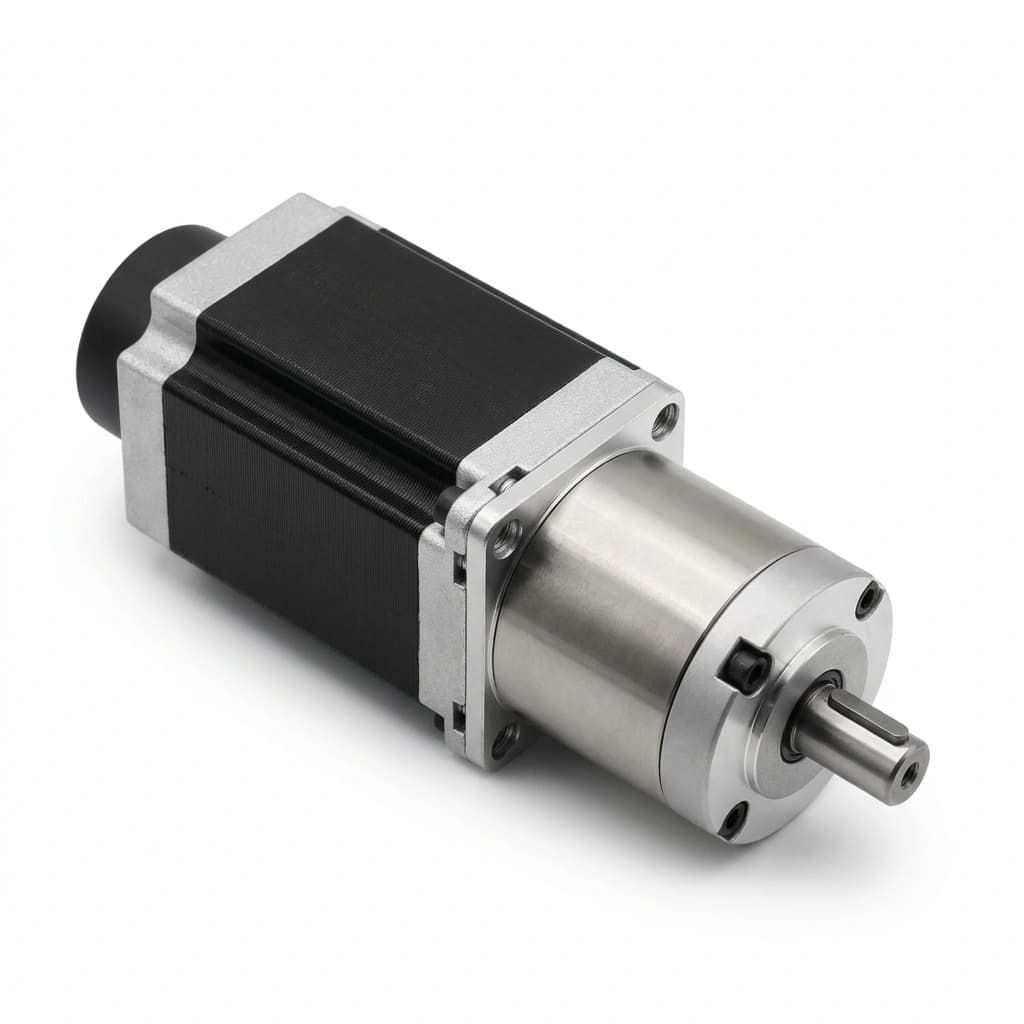
The gearbox trades speed for torque. Motor torque is multiplied by the gear ratio and efficiency, while output speed is divided by the gear ratio.
di/dt = (V - E)/L limits RPM
Because stepper coils are highly inductive, 12V provides insufficient "electrical pressure" to reach rated current during the very short step windows at high RPM. Gearboxes are mandatory for high torque on a 12V bus because they allow the motor to operate slowly where current has time to build.
Evidence path: TI AN-828 and Oriental Motor voltage-performance guidance
600 RPM review trigger
The calculator flags motor-side speeds above 600 RPM as a conservative 12V review point. Oriental Motor notes that speed-torque performance depends on the motor and driver combination, including applied voltage, so the exact pass/fail line must come from the selected curve.
Evidence path: Oriental Motor speed-torque curve guide
Use datasheet efficiency
Estimated output torque is motor torque x gear ratio x efficiency. The page default is only a screening assumption; final sizing must use the selected gearbox family and ratio because efficiency and torque ratings vary by product.
Evidence path: Neugart PLFN catalog example plus supplier datasheet request
Output step = motor step / ratio
A standard 1.8 deg step motor paired with a 10:1 gearbox achieves a 0.18 deg full-step output increment before microstepping. Treat that as commanded resolution; backlash and load displacement still set real bidirectional accuracy.
Evidence path: Calculator method table and step-angle arithmetic
Validate arcmin at output
Mechanical play dominates reversing accuracy after the arithmetic looks feasible. Oriental Motor separates no-load motor accuracy from load displacement, and gearbox backlash must be added at the output shaft.
Evidence path: Oriental Motor accuracy caveat plus gearbox backlash data
The calculator defaults are intentionally conservative enough to audit by hand: 12V supply, 1.8 degree motor, 1/16 microstep, 16,000 Hz pulse rate, 5.18:1 gearbox, 0.4 N.m holding torque, and 75% gearbox efficiency.
| Metric | Calculation | Result | Decision boundary |
|---|---|---|---|
| Supply voltage | 12 V calculator default | Screen as a 12V bus, not a 24V substitute | Use voltage-specific motor and driver curves for approval. |
| Motor-side speed | 16,000 / ((360 / 1.8) x 16) x 60 | 300 RPM | Below the 600 RPM review trigger, but still curve-dependent at 12V. |
| Output speed | 300 / 5.18 | 57.9 RPM | Acceptable only if the application can use this reduced speed. |
| Estimated output torque | 0.4 x 5.18 x 0.75 | 1.55 N.m | Compare against gearbox rated, peak, and duty-cycle torque limits. |
| Commanded output step | 1.8 / 5.18 / 16 | 0.0217 deg | Useful for command resolution; exclude backlash-sensitive accuracy claims. |
Use the calculator result as the first screen, then compare the pattern below to decide which evidence must be requested before production approval.
| Scenario | Assumptions | Likely result pattern | Recommendation |
|---|---|---|---|
| Small rotary indexer | 12V bus, 1.8 deg motor, 10:1 gearbox, moderate pulse rate | Low output RPM, improved commanded resolution, usually acceptable torque margin when load inertia is small. | Proceed to supplier curve review and backlash check before fixture approval. |
| Fast conveyor adjustment | 12V bus, low gear ratio, high pulse rate, frequent starts | Motor-side RPM can cross the 600 RPM review trigger before output torque looks risky. | Compare 24V/48V drive voltage or reduce acceleration before selecting the gearbox. |
| Bidirectional valve or damper | High ratio gearbox, repeated reversing, position repeatability required | Calculated resolution looks strong, but backlash and shaft compliance dominate output accuracy. | Request arcmin backlash data and consider output-side feedback or anti-backlash reducer options. |
| Gearbox Type | Efficiency | Backlash | Torque Capacity | Best For |
|---|---|---|---|---|
| Planetary Gearbox | PLFN example: 97% one-stage / 96% two-stage at full load; use exact datasheet | PLFN example: 1–5 arcmin torsional backlash; reduced-backlash options vary by family | High, but capped by exact gearbox rating | Precision CNC, Robotics, Space-constrained high torque |
| Spur Gearbox | Supplier-specific; request measured value | Often higher than precision planetary unless anti-backlash gears are specified | Low to moderate unless gearbox rating says otherwise | Cost-sensitive, light load, one-direction continuous motion |
| Worm Gear | Supplier-specific; can be materially lower | Supplier-specific; self-locking is not automatic | Useful for holding loads only when rated for it | Lifting applications where self-locking on power-off is required |
Mitigation: High gear ratios can produce calculated torque that exceeds the reducer rating even when the motor is small. Always check rated output torque, peak torque, emergency-stop torque, and life limits rather than approving from multiplication alone.
Mitigation: Treat motor-side speed above 600 RPM as a 12V review trigger. If the application demands higher output RPM, compare a lower gear ratio, 24V/48V driver stack, or a different motor using voltage-specific torque-speed curves.
Mitigation: Use a closed-loop encoder on the output shaft or select a gearbox with a published backlash class if bidirectional accuracy is critical. Treat unknown backlash as an RFQ blocker until the supplier provides arcmin or degree data.
Evidence was checked on July 28, 2026. Published catalog values are used as traceable examples, not universal claims for every 12V geared stepper sold online.
| Calculator item | Formula | Decision use | Limit |
|---|---|---|---|
| Motor-side speed | RPM = pulse rate / ((360 / step angle) x microstep) x 60 | Checks whether the commanded pulse rate creates a practical motor speed. | Does not include acceleration profile, pull-in torque, or torque drop from the selected driver. |
| Output speed | Output RPM = motor RPM / gear ratio | Converts a motor command into gearbox output speed. | Assumes the gearbox is not slipping and the motor stays synchronized. |
| Estimated output torque | Torque = motor holding torque x gear ratio x efficiency | Creates an early torque screen before RFQ. | Holding torque is not available at speed; use the torque-speed curve for final sizing. |
| Output step resolution | Resolution = step angle / gear ratio / microstep | Shows commanded angular increment at the output shaft. | Microstep smoothness and commanded increment do not guarantee absolute positioning accuracy. |
Stepper motor physics: voltage vs current rise time
TI explains that high-speed torque depends on how quickly the driver can force current through the windings. Real winding current is governed by L/R time constants, applied voltage, and motor back EMF; increasing the applied voltage raises current slew rate and high-speed torque when current is regulated.
Source: Texas Instruments AN-828: Increasing the High Speed Torque of Bipolar Stepper Motors | Checked 2026-07-28
Boundary: The exact RPM where torque collapses depends heavily on the specific motor's inductance rating.
Drive voltage and high-speed performance
Oriental Motor explains that high drive-voltage-to-motor-voltage ratio improves high-speed performance because higher voltage drives current into the windings faster.
Source: Oriental Motor stepper motor basics | Checked 2026-07-28
Boundary: This supports the 12V caution, but final motor choice still requires the selected driver and motor curve.
Speed-torque curve and voltage dependency
Oriental Motor states that speed-torque curves show available torque at speed for a motor and driver combination, and that power input / applied voltage belongs on the curve. It also states that higher applied voltage generally allows faster rotation and better torque at speed.
Source: Oriental Motor speed-torque curve guide | Checked 2026-07-28
Boundary: The 600 RPM threshold on this page is a conservative 12V screening trigger, not an Oriental Motor universal limit.
Start/stop and slew range boundary
Oriental Motor explains that a stepper cannot start directly in the slew range; it must start in the self-start range, accelerate into slew, then decelerate back before stopping.
Source: Oriental Motor speed-torque curve guide | Checked 2026-07-28
Boundary: The calculator does not model ramp profile, inertia, or pull-in torque. Use it before, not instead of, motion-profile validation.
Stepper accuracy and reversing caveat
Oriental Motor states angle accuracy within +/-3 arc minutes (+/-0.05 deg) under no-load conditions, and notes that bi-directional operation can produce double the displacement angle over a round trip.
Source: Oriental Motor stepper motor overview | Checked 2026-07-28
Boundary: This is motor-side no-load behavior. Gearbox backlash, load friction, and coupling compliance still need output-side validation.
Planetary gearbox reference envelope
The Neugart PLFN catalog chapter gives a traceable example of published reducer data: full-load efficiency by stage count, torsional backlash range, nominal/cyclic torque, radial force, axial force, temperature, and service-life conditions.
Source: Neugart PLFN catalog chapter | Checked 2026-07-28
Boundary: Use as a traceable planetary reference, not as a claim for every low-cost gearbox sold with a 12V stepper.
| Decision | Trust when | Verify when | Next action |
|---|---|---|---|
| Can the calculator approve the motor? | You need deterministic arithmetic for speed, ideal torque, and commanded resolution. | The result will drive a purchase, safety margin, acceleration profile, or warranty claim. | Request motor torque-speed curve at the actual driver voltage and current. |
| Can the output torque be trusted? | The calculated value is far below the gearbox rated output torque and duty is light. | The estimate approaches gearbox rating, cycle duty is high, or shock load exists. | Ask for rated, peak, emergency-stop, and life-limited torque values. |
| Can the resolution number be trusted? | You only need commanded increment or smooth low-speed motion. | You need bidirectional accuracy, repeatability, or no-backlash reversing. | Add gearbox backlash, coupling play, encoder location, and load friction to the error budget. |
| RFQ evidence item | Why it matters | Ask supplier for | Fallback if unknown |
|---|---|---|---|
| 12V torque-speed curve | Confirms available running torque at the calculated motor RPM. | Curve at actual driver voltage, phase current, and microstep mode. | Treat motor-side speed above 600 RPM as a review risk. |
| Gearbox rated and peak output torque | Prevents ideal torque multiplication from exceeding mechanical limits. | Rated, peak, emergency-stop, and duty-cycle-limited torque values. | Do not approve if calculated torque approaches the rating. |
| Backlash and measurement condition | Sets reversing accuracy after gear reduction and microstepping. | Backlash in arcmin or degrees, measured at stated torque/load condition. | Treat unknown backlash as unsuitable for bidirectional precision. |
| Radial and axial load limits | Protects the output bearing and gearbox life under coupled loads. | Permissible radial/axial force at shaft location and service life basis. | Add external bearing support or choose a reducer with published loads. |
Send us your calculated speed, torque requirements, and physical constraints. Our engineers will match you with the right planetary or spur gear assembly, ensuring the 12V supply limits are safely accommodated.
Inquiry Email
